Book guide and evaluation
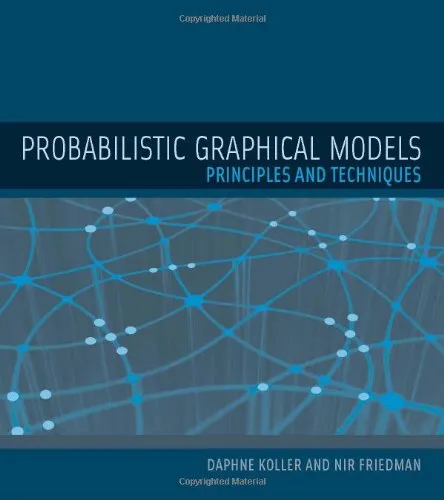
Probabilistic Graphical Models: Principles and Techniques
Daphne Koller,Nir Friedman
English
Beginner
Data Science
4.8 / 5
0 reviews
2009
Published
1270
pages
532
views
Most tasks require a person or an automated system to reason--to reach conclusions based on available information. The framework of probabilistic graphical models, presented in this book, provides a general approach for this task. The approach is model-based, allowing interpretab
Before you read
What will you get from this book?
Most tasks require a person or an automated system to reason--to reach conclusions based on available information. The framework of probabilistic graphical models, presented in this book, provides a general approach for this task. The approach is model-based, allowing interpretable models to be constructed and then manipulated by reasoning algorithms. These models can also be learned automatically from data, allowing the approach to be used in cases where manually constructing a model is difficult or even impossible. Because uncertainty is an inescapable aspect of most real-world applications, the book focuses on probabilistic models, which make the uncertainty explicit and provide models that are more faithful to reality. Probabilistic Graphical Models discusses a variety of models, spanning Bayesian networks, undirected Markov networks, discrete and continuous models, and extensions to deal with dynamical systems and relational data. For each class of models, the text describes the three fundamental cornerstones: representation, inference, and learning, presenting both basic concepts and advanced techniques. Finally, the book considers the use of the proposed framework for causal reasoning and decision making under uncertainty. The main text in each chapter provides the detailed technical development of the key ideas. Most chapters also include boxes with additional material: skill boxes, which describe techniques; case study boxes, which discuss empirical cases related to the approach described in the text, including applications in computer vision, robotics, natural language understanding, and computational biology; and concept boxes, which present significant concepts drawn from the material in the chapter. Instructors (and readers) can group chapters in various combinations, from core topics to more technically advanced material, to suit their particular needs.
Ask this book
Your question is answered in the context of this title and author. Each answer uses 2 points.
Sign in to ask the book assistant.
Reader reviews
0 reviews, 4.8 average out of 5
No reviews yet
If you have read this book, help the next reader with your experience.
Write a review
Sign in to publish a review.
Reader questions and answers
Ask a focused question and learn from the community.
Sign in to ask or answer a question.
No questions yet
Be the first to ask a clear, useful question.
What to read next
Related references that continue this learning path.