
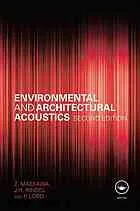
Book guide and evaluation
Environmental and architectural acoustics
Rindel, Jens Holger;Maekawa, Z.;Lord, Peter
English
Beginner
Engineering
4.5 / 5
0 reviews
2011
Published
371
pages
320
views
Introduction to 'Environmental and Architectural Acoustics' Delving into the nuances of how sound interacts with the built environment and natural landscapes, 'Environmental and Architectural Acoustics' is a comprehensive guide for architects, engineers, and anyone interested
Before you read
What will you get from this book?
Introduction to 'Environmental and Architectural Acoustics'
Delving into the nuances of how sound interacts with the built environment and natural landscapes, 'Environmental and Architectural Acoustics' is a comprehensive guide for architects, engineers, and anyone interested in creating spaces with optimal acoustic performance. This book, authored by Jens Holger Rindel, Z. Maekawa, and Peter Lord, offers a blend of scientific rigor and practical applications to address sound-related challenges in various settings.
Detailed Summary
Spanning the essential principles of acoustics to advanced design strategies, this book provides readers with a structured understanding of sound propagation, absorption, and control in diverse environments. From historic spaces like concert halls to modern office buildings, the authors tackle complex acoustic designs that balance functionality and aesthetics. The book addresses outdoor environmental noise, including transportation and industrial sources, alongside indoor acoustic design principles.
The authors present discussions at three levels: the physics of sound, sound perception by humans, and the design strategies for improving acoustic performance. Over its chapters, readers learn about pivotal concepts such as reflection, reverberation, masking effects, and psychoacoustics. Additionally, there is an exploration of the impacts of noise pollution on health and how urban planners can mitigate environmental noise to improve livability in cities.
A unique aspect of this book is its balance between theoretical knowledge and real-world case studies. Architectural acoustics take the spotlight in sections where concert hall design, sound insulation, and optimization of spaces for speech and music are explained. Meanwhile, environmental acoustics covers mitigating road traffic noise, urban soundscapes, and the integration of green infrastructure in acoustical planning. The combined expertise of the authors ensures a multidisciplinary perspective throughout the book, making it both comprehensive and actionable.
Key Takeaways
- Learn the fundamental physics of sound and how it propagates in different environments.
- Understand human auditory perception and its implications for architectural design.
- Explore cutting-edge design strategies for optimizing acoustics in buildings and landscapes.
- Gain insights into controlling environmental noise and creating healthier urban environments.
- Dive into practical applications with case studies on iconic architectural and environmental acoustic projects.
Famous Quotes from the Book
"The world of sound is not a separate realm—it is an essential layer of the places we inhabit, shaping human experience in profound ways."
"Effective acoustic design harmonizes with architectural vision, creating spaces that function as well as they inspire."
Why This Book Matters
In an era where urbanization and noisy environments have an undeniable impact on human health, understanding acoustics becomes vital. Whether you are a professional aiming to design quieter cities or a student passionate about architecture, this book will enhance your perspective on the role of sound in shaping human experiences.
What sets this book apart is its ability to bridge theory and application. With a foundation in physics and psychoacoustics, the authors empower readers to approach acoustic challenges holistically. Moreover, the integration of sustainability principles in acoustic design reflects its relevance in contemporary contexts.
Ultimately, 'Environmental and Architectural Acoustics' matters because it elevates the conversation around sound. It recognizes acoustics not merely as a technical discipline but as an intrinsic element of creating livable, efficient, and aesthetically pleasing environments.
Ask this book
Your question is answered in the context of this title and author. Each answer uses 2 points.
Sign in to ask the book assistant.
Reader reviews
0 reviews, 4.5 average out of 5
No reviews yet
If you have read this book, help the next reader with your experience.
Write a review
Sign in to publish a review.
Reader questions and answers
Ask a focused question and learn from the community.
Sign in to ask or answer a question.
No questions yet
Be the first to ask a clear, useful question.
What to read next
Related references that continue this learning path.
Shaping Climate Friendly Transport in Europe: Key Findings & Future Directions, REACT 2011, Proceedings
Zoran Radmilović,Dragan Čišić (eds.)
2011
View book