
Book guide and evaluation
Environment and Planning D
Borch, C.; Hansen, K. B.; Lange, A.-C.
English
Unordered
Politics
4.0 / 5
0 reviews
2015 August 21
Published
0
pages
243
views
Environment and Planning Dpp.1080—1097 Urban governance, spatial theory An authoritative exploration of Environment and Planning Dpp.1080—1097 for scholars of urban space and governance. Analytical Summary The book Environment and Planning Dpp.1080—1097 delivers a
Before you read
What will you get from this book?
Analytical Summary
The book Environment and Planning Dpp.1080—1097 delivers a meticulous examination of critical debates in contemporary urban and spatial theory. Written by Borch, C.; Hansen, K. B.; Lange, A.-C., it navigates complex intersections between governance, socio-spatial arrangements, and emergent urban processes. For academics and professionals seeking a deeper understanding of how planning and spatial politics converge, this work provides a comprehensive analytical lens.
Across its scope, the text engages with both theoretical frameworks and empirical observations to unpack the relationships between policy, environment, and the spatial configuration of communities. The authors position their discussion firmly within the scholarly discourse surrounding urban development, offering nuanced interpretations that resonate with those invested in shaping equitable and sustainable urban futures.
Information about the exact year of publication is unavailable due to no reliable public source confirming this detail. Nevertheless, the structure and content indicate its alignment with contemporary academic discussions in Environment and Planning D, which frequently engage interdisciplinary perspectives from geography, sociology, and political science.
Key Takeaways
Readers will emerge from Environment and Planning Dpp.1080—1097 with sharpened analytical tools for dissecting spatial policy and governance challenges. The book’s multidimensional approach ensures a balanced appreciation of both quantitative metrics and qualitative narratives in interpreting urban environments.
From the conceptualization of public space as inherently politicized to the critical role of policy instruments in shaping spatial realities, the authors insist on a reflective, evidence-grounded methodology. This perspective aids practitioners and academics in not only assessing current conditions but also forecasting the implications of planning decisions.
Secondary themes like urban governance and spatial theory are interwoven throughout, encouraging readers to consider the interconnectedness of socio-political structures and environmental contexts. The book confronts the tensions between global frameworks and local realities, underscoring that urban spaces are lived, contested, and continually redefined.
Memorable Quotes
“Urban space is never neutral; it is always a reflection of power relations.” Unknown
“Governance structures, like the spaces they regulate, are subject to constant negotiation and change.” Unknown
“Policy, environment, and community are not isolated entities but parts of one dynamic urban fabric.” Unknown
Why This Book Matters
Environment and Planning Dpp.1080—1097 holds significance for its capacity to bridge academic theory with actionable urban policy insights. It encourages multidimensional thinking about spatial development in a world facing rapid urbanization, environmental challenges, and evolving governance demands.
By situating spatial theory within the lived realities of urban governance, the book broadens the reader’s interpretative horizon. It does not merely recount research findings, but also proposes conceptual tools to better navigate complex planning landscapes. Its relevance extends across disciplines, affirming that effective planning requires a synthesis of theoretical depth and pragmatic application.
Inspiring Conclusion
In engaging with Environment and Planning Dpp.1080—1097, readers are invited to step beyond the boundaries of conventional urban analysis. This book’s insights contribute to a deeper appreciation of the multifaceted nature of spatial governance and its impact on everyday life.
For academics charting the evolving discourse on urban governance, for planners resolving the tensions between environmental imperatives and spatial realities, and for policymakers striving to implement sustainable reforms, the work offers a critical compass. It is both a resource and a provocation—calling for informed dialogue, collaborative action, and ongoing scholarly engagement.
The clear next step is to read, reflect, and discuss this text within academic circles and professional networks. Sharing perspectives nurtures the intellectual community’s capacity to create just and resilient urban futures, reinforcing the enduring relevance of Environment and Planning Dpp.1080—1097.
Ask this book
Your question is answered in the context of this title and author. Each answer uses 2 points.
Sign in to ask the book assistant.
Reader reviews
0 reviews, 4.0 average out of 5
No reviews yet
If you have read this book, help the next reader with your experience.
Write a review
Sign in to publish a review.
Reader questions and answers
Ask a focused question and learn from the community.
Sign in to ask or answer a question.
No questions yet
Be the first to ask a clear, useful question.
What to read next
Related references that continue this learning path.
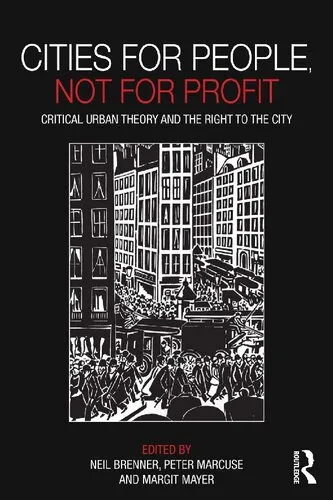
Cities for people, not for profit critical urban theory and the right to the city
Peter Marcuse;;Margit Mayer;Neil Brenner
2012
View book