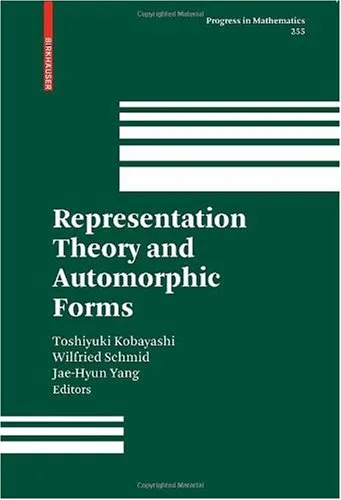
Representation theory and automorphic forms
Toshiyuki Kobayashi,Wilfried Schmid,Jae-Hyun Yang
2008
View book
Book guide and evaluation
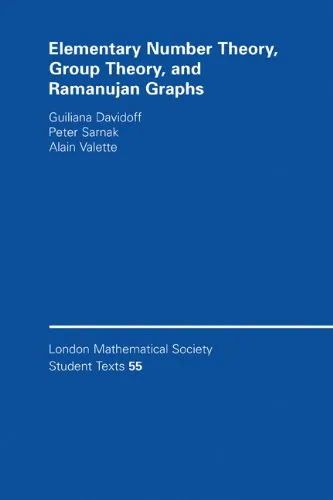
Giuliana Davidoff,Peter Sarnak,Alain Valette
0 reviews
Published
pages
views
Welcome to the fascinating world of "Elementary Number Theory, Group Theory, and Ramanujan Graphs," a book that intertwines three profound areas of mathematics to explore their beautiful interconnections. Authored by Giuliana Davidoff, Peter Sarnak, and Alain Valette, this bo
Before you read
Welcome to the fascinating world of "Elementary Number Theory, Group Theory, and Ramanujan Graphs," a book that intertwines three profound areas of mathematics to explore their beautiful interconnections. Authored by Giuliana Davidoff, Peter Sarnak, and Alain Valette, this book serves as both an introduction and an in-depth exploration of its subjects, appealing to both the novice and seasoned mathematician.
The book is a comprehensive guide that provides insights into elementary number theory and group theory, utilizing these fields to unravel the mysteries of Ramanujan graphs. The authors embark on this mathematical journey by introducing readers to fundamental concepts in number theory, such as divisibility, primes, and modular arithmetic. This foundation is vital for the exploration of groups, rings, and fields, which are pivotal structures in group theory.
Once these essentials are established, the narrative delves into the heart of the Ramanujan graphs. These graphs are named after the eminent mathematician Srinivasa Ramanujan and represent remarkable examples of expander graphs with profound implications in mathematics and computer science. The text elucidates how these graphs serve as optimal network designs, maximizing speed and efficiency—a concept with significant practical applications.
The authors' treatment of these topics is accessible yet rigorous, employing a clear and concise writing style supported by numerous examples and exercises. This approach enables readers to not only comprehend theoretical underpinnings but also apply their newfound knowledge to complex problems within mathematics and beyond.
"In mathematics, the challenge is not in knowing what is true, but in understanding why it is true."
"The interplay between group theory and number theory is like a symphony, where each plays its part in harmony."
This book matters because it addresses the ever-growing need to build bridges between different mathematical disciplines and their real-world applications. It acts as an educational tool for undergraduate and graduate students who need to grasp these complex yet rewarding topics. Moreover, it is invaluable for researchers and practitioners who want to employ these principles in technological advancements, particularly in computer science and communications engineering.
The amalgamation of theory and practical application in "Elementary Number Theory, Group Theory, and Ramanujan Graphs" offers a unique perspective that advances our understanding of how abstract mathematical concepts can drive technological innovation and efficiency. This is an essential read for anyone keen on exploring the deep connections within mathematics and its implications.
Your question is answered in the context of this title and author. Each answer uses 2 points.
0 reviews, 4.5 average out of 5
Sign in to publish a review.
Ask a focused question and learn from the community.
Related references that continue this learning path.
Toshiyuki Kobayashi,Wilfried Schmid,Jae-Hyun Yang