
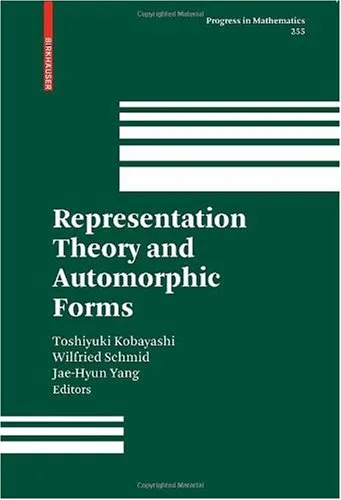
Representation theory and automorphic forms
Toshiyuki Kobayashi,Wilfried Schmid,Jae-Hyun Yang
2008
View book
Book guide and evaluation
Tall, David Orme;Stewart, Ian
0 reviews
Published
pages
views
Welcome to the fascinating world of algebraic number theory and the intricacies connected to one of mathematics’ most legendary problems, Fermat's Last Theorem. This book, "Algebraic Number Theory and Fermat’s Last Theorem," serves as both an introduction and a deep dive int
Before you read
Welcome to the fascinating world of algebraic number theory and the intricacies connected to one of mathematics’ most legendary problems, Fermat's Last Theorem. This book, "Algebraic Number Theory and Fermat’s Last Theorem," serves as both an introduction and a deep dive into the concepts that have intrigued mathematicians for centuries.
The book opens with a historical context of Fermat’s Last Theorem, a problem that remained unsolved for over 350 years. Pierre de Fermat famously noted in 1637 that there are no whole number solutions to the equation xn + yn = zn} for n greater than 2. This statement became one of mathematics' most enduring challenges.
To understand the theorem’s complexities, we delve into the rich tapestry of algebraic number theory, providing the necessary mathematical background through detailed explanations and comprehensive illustrations. The book explores concepts such as number fields, ring theory, Galois theory, and modular forms, which play a significant role in the proof of Fermat’s Last Theorem.
Subsequent chapters discuss the groundbreaking work of Andrew Wiles, who, in the 1990s, provided the first complete proof of Fermat's Last Theorem. The book examines the strategies Wiles employed, including his revolutionary use of elliptic curves and modular forms, as well as the technical challenges he overcame in his proof.
Throughout the book, several notable passages capture the essence of the subject:
"No other problem in the history of mathematics has captured so much interest from mathematicians and amateurs alike as Fermat's Last Theorem."
"Algebraic number theory serves as the hidden architecture within the grand mansion of mathematics."
"Wiles' proof stands as a testament not only to his brilliance but also to the power of human ingenuity and determination."
The relevance of "Algebraic Number Theory and Fermat’s Last Theorem" extends beyond its scholarly appeal. It provides deep insights into how classical problems in mathematics can inspire innovative approaches that lead to breakthroughs in entirely new areas. By unraveling the proof of Fermat's Last Theorem, the book not only celebrates one of the 20th century's greatest mathematical achievements but also serves as a communication bridge, bringing complex mathematical ideas to a broader audience.
A comprehensive understanding of algebraic number theory is crucial for anyone interested in pursuing advanced studies in mathematics or related disciplines. This book breaks down these complex topics, making them accessible and engaging, thus serving as an invaluable resource for students, educators, and enthusiasts.
Moreover, by examining the intricate details of Fermat’s Last Theorem and Wiles’ proof, the book illustrates the process and excitement of mathematical discovery. It illuminates the dedication, creativity, and collaborative spirit necessary for solving difficult problems, aspects that are invaluable in any field of study or industry.
Your question is answered in the context of this title and author. Each answer uses 2 points.
0 reviews, 4.5 average out of 5
Sign in to publish a review.
Ask a focused question and learn from the community.
Related references that continue this learning path.
Toshiyuki Kobayashi,Wilfried Schmid,Jae-Hyun Yang
Giuliana Davidoff,Peter Sarnak,Alain Valette
![Cover of Algebraic Number Theory and Fermat’s Last Theorem [4th ed.]](https://s3.refhub.ir/images/thumb/Algebraic_Number_Theory_and_Fermat_s_Last_The_17530.webp)