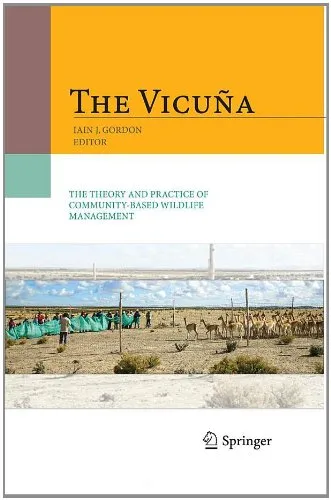
The Vicuna: The Theory and Practice of Community Based Wildlife Management
Iain Gordon (auth.),Iain J. Gordon (eds.)
2009
View book

Book guide and evaluation
Pagnucco, Katie S.; Paszkowski, Cynthia A.; Scrimgeour, Garry J.
0 reviews
Published
pages
views
Ecosciencepp.70—78 Ecological research methods, aquatic ecosystem management Ecosciencepp.70—78 offers deep insights into ecological dynamics and environmental stewardship for professionals and scholars. Analytical Summary Ecosciencepp.70—78 presents a critical ex
Before you read
Ecosciencepp.70—78 presents a critical examination of ecological systems with a particular focus on the nuanced interplay between terrestrial and aquatic environments. This section of the work by Pagnucco, Katie S.; Paszkowski, Cynthia A.; and Scrimgeour, Garry J. delves into rigorous field investigations and analytical models that bridge theory with applied environmental science. It provides an authoritative lens for understanding how ecosystems respond to natural and anthropogenic pressures.
Drawing on methodical ecological research, the book segment addresses habitat connectivity, species distribution, and bioindicator utility. Each page is layered with empirical observations, highlighting both qualitative and quantitative dimensions of ecosystem assessment. These analyses serve as a vital resource for academics and professionals seeking to develop informed conservation strategies.
Although specific publication year information is unavailable due to no reliable public source, the content holds enduring relevance within ecological literature. Themes explored include the interdependence of species and their habitats, the function of wetlands in regional biodiversity stability, and sustainable management practices.
From Ecosciencepp.70—78, readers glean precise understanding of ecological system operations and management strategies. The authors present frameworks adaptable to diverse environmental contexts and stress the importance of evidence-based policy creation.
One major takeaway is that ecological health can be monitored through integrative approaches combining biological indicators and physical environmental parameters. Another is the necessity of maintaining aquatic ecosystem integrity as a cornerstone of biodiversity support. Finally, it underscores that sustainable resources management requires ongoing engagement from both scientific and local communities.
"The integrity of aquatic ecosystems is not a luxury; it is a necessity for sustaining biodiversity." Unknown
"Ecological indicators are only as valuable as the context in which they are interpreted." Unknown
"Connectivity across habitats dictates the resilience of ecological communities." Unknown
Ecosciencepp.70—78 is a valuable asset for professionals, scholars, and decision-makers who require scientifically rigorous, context-sensitive insights into ecosystem dynamics.
The work’s emphasis on integrating ecological research methods with practical management applications ensures its relevance for contemporary environmental challenges. By fostering a deeper understanding of aquatic ecosystem management and the principles guiding conservation, the authors contribute to informed stewardship of natural resources.
In synthesizing the detailed fieldwork and interpretive analysis contained in Ecosciencepp.70—78, it becomes evident that this book section is not merely an academic reference, but a call to integrate ecological science into actionable conservation measures.
For the serious reader, policymaker, or researcher, the text provides both the conceptual frameworks and practical tools needed to address complex environmental systems. By engaging with its insights on ecological research methods and aquatic ecosystem management, readers are better equipped to influence sustainable outcomes. The clear next step: immerse yourself in the depth of Ecosciencepp.70—78, share its findings with your professional networks, and provoke meaningful discussions that transform policy and practice.
Your question is answered in the context of this title and author. Each answer uses 2 points.
0 reviews, 4.5 average out of 5
Sign in to publish a review.
Ask a focused question and learn from the community.
Related references that continue this learning path.
Iain Gordon (auth.),Iain J. Gordon (eds.)