Book guide and evaluation
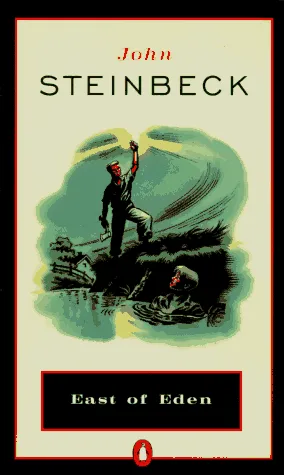
East of Eden
John Steinbeck
English
Intermediate
novel
4.4 / 5
0 reviews
1979
Published
465
pages
673
views
Introduction to "East of Eden" Welcome to the immersive world of John Steinbeck's "East of Eden," a sprawling novel that intricately weaves timeless themes of good versus evil, love and betrayal, and the quest for identity. This narrative masterpiece, set against t
Before you read
What will you get from this book?
Introduction to "East of Eden"
Welcome to the immersive world of John Steinbeck's "East of Eden," a sprawling novel that intricately weaves timeless themes of good versus evil, love and betrayal, and the quest for identity. This narrative masterpiece, set against the backdrop of the rich and fertile Salinas Valley in California, explores the intricate dynamics of two families—the Trasks and the Hamiltons—over several generations. Steinbeck crafts a profound exploration of human nature, imbibing a tapestry of allegory, vivid characters, and powerful plotlines that evoke an enduring sense of universality and introspection.
Detailed Summary of the Book
"East of Eden" is an expansive and ambitious narrative that covers the lives of two main families over generations, reflecting the Biblical story of Cain and Abel. Beginning with the settlement of the Hamilton family in the Salinas Valley, the novel introduces us to Samuel Hamilton, an Irish immigrant whose warmth and creativity endear him to the community. Opposite the saintly Hamiltons are the complex Trasks—beginning with Adam Trask who inherits wealth from his father.
Central to the story is the tumultuous relationship between Adam Trask and his brother, Charles, whose lives parallel the Biblical tale of sibling rivalry. This motif is further underscored in the next generation through Adam's twin sons, Aron and Cal. As the saga unfolds, characters grapple with moral dilemmas and existential questions, often mirroring the Biblical allegories that Steinbeck threads throughout the novel.
Key Takeaways
One of the most compelling takeaways from "East of Eden" is the exploration of the innate capacity for good and evil within us all. Steinbeck delves into notions of free will, suggesting through the powerful concept of "timshel," which means "thou mayest," that each individual possesses the potential to choose their path. The novel suggests that despite circumstances or inherent traits, the ability to choose one's destiny remains paramount.
Additionally, the novel emphasizes the influence of heritage and upbringing on personal identity, highlighting how generational cycles of behavior can perpetuate or be broken. Through the vivid landscapes of Salinas Valley, Steinbeck also celebrates the human connection to land and place, embedding the story in a deep sense of geography and time.
Famous Quotes from the Book
- "And now that you don’t have to be perfect, you can be good."
- "I believe there is one story in the world, and only one, that has frightened and inspired us... humans are caught—in their lives, in their thoughts, in their hungers and ambitions, in their avarice and cruelty, and in their kindness and generosity too—in a net of good and evil."
- "Timshel—thou mayest—this gives a choice. It might be the most important word in the world. That says the way is open."
Why This Book Matters
"East of Eden" remains a cornerstone of American literature for its profound exploration of universal themes and its narrative mastery. Steinbeck succeeds in creating a microcosm of moral exploration within the panoramic scope of American history and tradition. By embedding age-old questions within the deeply personal journeys of richly crafted characters, the novel invites readers to reflect on their own moral compass and choices.
Steinbeck's intricate prose and ability to capture the human condition with such intricacy make "East of Eden" not only a literary epic but also a philosophical treatise on the perpetual battle between good and evil. It is a timeless reflection on human nature and the complexities of the human psyche, securing its eternal significance in literary and cultural discussions.
Ask this book
Your question is answered in the context of this title and author. Each answer uses 2 points.
Sign in to ask the book assistant.
Reader reviews
0 reviews, 4.4 average out of 5
No reviews yet
If you have read this book, help the next reader with your experience.
Write a review
Sign in to publish a review.
Reader questions and answers
Ask a focused question and learn from the community.
Sign in to ask or answer a question.
No questions yet
Be the first to ask a clear, useful question.
What to read next
Related references that continue this learning path.
One hundred years of solitude: by Gabriel García Márquez
Stavans, Ilan;Garcia Marquez, Gabriel
2011
View book