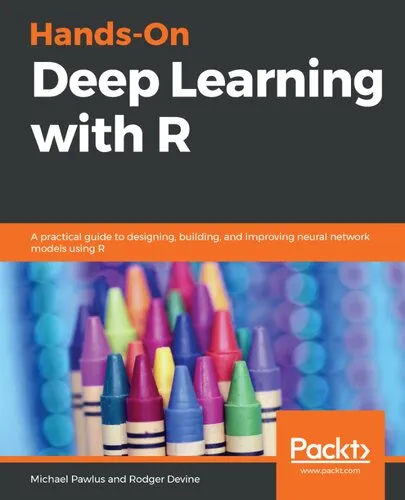
Hands-On Deep Learning with R: A practical guide to designing, building, and improving neural network models using R
Michael Pawlus,Rodger Devine
2020
View book
Book guide and evaluation
Lutz Trautmann,Rudolf Rabenstein (auth.)
0 reviews
Published
pages
views
Introduction to "Digital Sound Synthesis by Physical Modeling Using the Functional Transformation Method" "Digital Sound Synthesis by Physical Modeling Using the Functional Transformation Method" is an advanced and comprehensive text that explores the cutting-edge realm of
Before you read
"Digital Sound Synthesis by Physical Modeling Using the Functional Transformation Method" is an advanced and comprehensive text that explores the cutting-edge realm of sound synthesis through the lens of mathematical modeling. Authored by Lutz Trautmann and Rudolf Rabenstein, this book delves into the revolutionary Functional Transformation Method (FTM) as an effective approach for simulating acoustic systems. For enthusiasts, researchers, and professionals in audio engineering, this work provides crucial theoretical and practical insights into synthesizing realistic digital sounds directly derived from the physics of sound-producing objects.
Physical modeling in sound synthesis has fundamentally shifted the way we create and analyze auditory experiences in digital form. Unlike other approaches, the Functional Transformation Method stands out for its powerful mathematical framework, which is capable of integrating complex systems of differential equations that describe physical phenomena. By presenting both the theory and its applications, Trautmann and Rabenstein offer a compelling, in-depth guide to those aspiring to master sophisticated modeling techniques. Whether you are interested in musical instrument synthesis, sound design, or the development of virtual acoustic environments, this book is a valuable resource that bridges theory with practical implementation.
The book begins with a fundamental overview of digital sound synthesis and its historical development, emphasizing physical modeling techniques for realistic and controllable sound generation. It then introduces the cornerstone of the text—the Functional Transformation Method (FTM)—as a robust framework for tackling the mathematical complexities associated with sound modeling.
Key topics include the derivation of governing equations for sound-producing systems, such as strings, membranes, tubes, and plates. The authors explore boundary conditions, initial value problems, and the numerical implementation challenges faced in physical modeling methods. A major strength of the book lies in its systematic explanation of how the FTM provides exact solutions or numerically stable approximations for these problems, offering significant advantages over traditional computational approaches.
Within its chapters, readers will also encounter detailed examples, mathematical derivations, and case studies of musical instruments like guitars, drums, and wind instruments. By connecting abstract mathematical concepts with tangible sound modeling scenarios, the authors make an otherwise complex subject accessible and engaging. The book concludes with practical implementation strategies, emphasizing how the FTM can be efficiently applied with modern computational tools to achieve high-quality digital sound synthesis.
"Physical modeling sound synthesis is not merely a simulation; it is an endeavor to recreate the physics of sound, connecting the virtual with the tangible."
"In the Functional Transformation Method, we find not just a mathematical framework, but a creative tool for shaping the soundscapes of tomorrow."
This book is a cornerstone for anyone deeply invested in understanding the intersection of audio technology and applied mathematics. It provides a robust framework for physical modeling sound synthesis, a field that continues to grow in importance across industries such as music production, virtual reality, and gaming. By focusing on the Functional Transformation Method, the authors propose a groundbreaking solution to challenges traditionally faced by audio engineers and sound designers while working with complex acoustic systems.
Furthermore, the book's focus on rigorous mathematical analysis, detailed derivations, and real-life applications contributes to the academic field of audio research. It promotes innovation in sound technology and inspires readers to adopt science-driven approaches for creating immersive digital soundscapes. Whether you are a student, a professor, or an industry professional, engaging with this text will broaden your understanding of digital sound synthesis and empower you to push the boundaries of what can be achieved in audio engineering.
Your question is answered in the context of this title and author. Each answer uses 2 points.
0 reviews, 3.8 average out of 5
Sign in to publish a review.
Ask a focused question and learn from the community.
Related references that continue this learning path.
Michael Pawlus,Rodger Devine
AME - Association for