
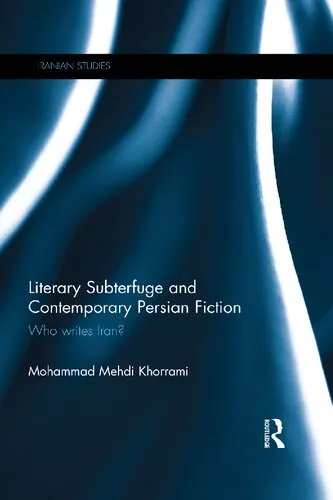
Literary Subterfuge and Contemporary Persian Fiction: Who Writes Iran?
Mohammad Mehdi Khorrami
2014
View book

Book guide and evaluation
Gullon, Ricardo; Márquez, Gabriel García; Rabassa, Gregory; Marquez, Gabriel Garcia
0 reviews
Published
pages
views
diacriticspp.27 literary criticism, linguistic analysis diacriticspp.27 offers deep insights into language, literature, and critical thought for scholars and professionals. Analytical Summary The book diacriticspp.27 stands as an engaging and rigorous exploration
Before you read
The book diacriticspp.27 stands as an engaging and rigorous exploration of language, literature, and the nuanced role of diacritical marks within critical discourse. Written by Gullón Ricardo, Gabriel García Márquez, and Gregory Rabassa, its collaborative nature weaves together perspectives from literary creation, translation, and academic commentary. The text moves fluidly between analytical frameworks, narrative examples, and linguistic examinations, making it an essential reference for those wishing to navigate the complex intersection between meaning and form.
While the publication year is information unavailable due to no reliable public source, the intellectual weight of the work is unmistakable. With essays and reflections that challenge conventional understandings of both syntax and semantics, diacriticspp.27 situates itself within a serious tradition of literary criticism. Themes of identity, cultural resonance, and textual precision permeate the pages, offering significant material for academics and professionals alike.
The book does not simply describe linguistic phenomena; rather, it interrogates how they shape narrative structures and reader perception. Drawing from the lived experience of authors and translators, it examines the interplay between originality and adaptation, celebrating the subtle artistry that typography and punctuation can embody.
Readers of diacriticspp.27 emerge with a heightened awareness of the hidden architecture within language and literature. Clear, precise communication is shown to depend not only on vocabulary and grammar but also on the finer details of diacritical usage.
The book’s insights into literary criticism encourage deeper reading practices, while its approach to linguistic analysis reveals how written symbols influence tone, emphasis, and even cultural interpretation. Moreover, academics will find valuable case studies illustrating translation challenges, an area Gregory Rabassa’s expertise illuminates with particular authority.
Another key outcome is the recognition that creative writing and critical theory are mutually reinforcing. Readers are invited to appreciate translation as an art form, where fidelity to source and clarity in target language require careful negotiation.
“The smallest mark can shift the largest meaning.” Unknown
“Translation is not replication; it is recreation within boundaries.” Unknown
“Criticism lives in the margin, where interpretation begins.” Unknown
Far from being a narrowly focused manual, diacriticspp.27 positions itself as a conversation across disciplines. Gullón brings scholarly insight into narrative form, García Márquez offers literary imagination, and Rabassa infuses precision from translation practice.
The result is a tapestry of knowledge that informs how we think about text as both art and science. Its value lies in encouraging meticulous attention to the elements often dismissed as secondary—diacritics, punctuation, and typographic nuances—which, in reality, shape comprehension as much as the chosen words.
For students of literary criticism and linguistic analysis, as well as seasoned professionals, the book is an invitation to expand the boundaries of their intellectual practice. It contextualizes technical details within a broader cultural and interpretive frame, underscoring their power to transform meaning.
With diacriticspp.27, readers gain more than analytical tools—they gain an enriched lens through which to view the written word. This synthesis of literary criticism and linguistic analysis is rare, and it invites us to see the smallest textual features as pivotal forces shaping narrative and thought.
For serious readers, academics, and professionals, the next step is clear: engage actively with the book’s ideas. Discuss them with peers, integrate them into research, and allow its perspectives to challenge and refine your understanding of textual nuance. diacriticspp.27 is not merely to be read; it is to be studied, shared, and debated—expanding the dialogue on how language lives and evolves.
Your question is answered in the context of this title and author. Each answer uses 2 points.
0 reviews, 4.5 average out of 5
Sign in to publish a review.
Ask a focused question and learn from the community.
Related references that continue this learning path.
Mohammad Mehdi Khorrami

Noam Chomsky,James McGilvray