

Data-Driven Science and Engineering: Machine Learning, Dynamical Systems, and Control
Steven L. Brunton,J. Nathan Kutz
2019
View book
Book guide and evaluation
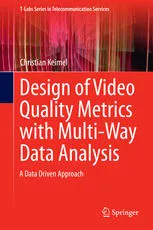
Christian Keimel (auth.)
0 reviews
Published
pages
views
Introduction Video consumption has become an integral part of our daily lives, from streaming services to video conferencing tools. This widespread use underscores the necessity of understanding and enhancing video quality. In my book, Design of Video Quality Metrics with
Before you read
Video consumption has become an integral part of our daily lives, from streaming services to video conferencing tools. This widespread use underscores the necessity of understanding and enhancing video quality. In my book, Design of Video Quality Metrics with Multi-Way Data Analysis: A Data Driven Approach, I tackle this challenge by providing a comprehensive and innovative framework for evaluating video quality in a scientific and systematic way.
Traditional methods of assessing video quality have either relied on subjective feedback from viewers or simplistic objective metrics. While both approaches have their merits, they fail to adequately reflect the nuances of modern video content and the complexity of user experiences. Leveraging multi-way data analysis, a mathematical tool designed to analyze datasets with multiple dimensions, this book offers a robust data-driven approach to designing video quality metrics. Whether you are a researcher, engineer, data scientist, or even a curious enthusiast, this book aims to impart valuable insights into how to quantify and optimize video quality effectively.
The book is structured to guide readers through a journey of understanding, starting from the fundamentals of video quality assessment to the advanced techniques of multi-way data analysis and their practical applications.
Initially, I lay the groundwork by discussing the importance of video quality metrics and why traditional methodologies often fall short. I delve into the types of distortions that can affect video content, such as compression artifacts and transmission errors, and how these distortions impact the viewing experience.
Subsequent chapters introduce multi-way data analysis techniques and how they can be applied to video quality assessment. I detail how tools like Tucker decomposition, CANDECOMP/PARAFAC, and tensor-based approaches provide deeper insights into the multi-dimensional nature of video data. Practical examples and case studies showcase the utility of these methods in designing objective and reliable video quality metrics.
Towards the end of the book, I tie everything together by focusing on validation and benchmarking of the proposed metrics, ensuring their applicability across diverse real-world scenarios. This holistic approach ensures that readers are well-prepared to design and implement robust video quality evaluation frameworks tailored to their specific needs.
“Video quality is not just about pixels; it is about experiences, emotions, and the seamless delivery of visual content to users.”
“Data-driven methodologies allow us to move from subjective opinions to objective measures, bringing science to the art of video quality assessment.”
“Understanding video quality is akin to solving a multidimensional puzzle; only by analyzing all dimensions can we see the full picture.”
With the exponential growth of video-based applications, maintaining video quality is no longer a luxury but a necessity. Video quality impacts not just user satisfaction but also the success of businesses in domains like entertainment, virtual reality, online learning, and telecommunication. Yet, the tools and techniques available for evaluating video quality often lag behind the rapidly evolving technology.
This book addresses this gap by equipping readers with both the theoretical knowledge and practical skills required to design state-of-the-art video quality metrics. It bridges the divide between academia and industry, offering a blend of foundational principles and actionable insights.
Furthermore, the integration of multi-way data analysis represents a paradigm shift in how we approach video quality assessment. By considering all dimensions of video data—spatial, temporal, and quality-specific factors—this approach provides a more comprehensive and reliable evaluation framework. It is a must-read for anyone involved in video processing, from content creators and streaming service providers to researchers and software engineers seeking to optimize user experience.
Above all, this book encourages readers to think critically about video quality and its broader implications in our increasingly digital world.
Your question is answered in the context of this title and author. Each answer uses 2 points.
0 reviews, 4.0 average out of 5
Sign in to publish a review.
Ask a focused question and learn from the community.
Related references that continue this learning path.
Steven L. Brunton,J. Nathan Kutz
Alan Chalmers, Patrizio Campisi, Peter ShirleyandIgor G. Olaizola (Eds.)


Aybat, Necdet Serhat;Bouwmans, Thierry;Zahzah, El-hadi