
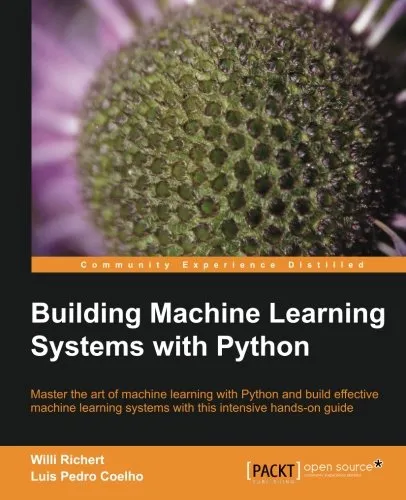

Book guide and evaluation
Handbook of robust low-rank and sparse matrix decomposition: applications in image and video processing
Aybat, Necdet Serhat;Bouwmans, Thierry;Zahzah, El-hadi
English
Beginner
Machine Learning
4.0 / 5
0 reviews
2016
Published
552
pages
607
views
Introduction to the Handbook The Handbook of Robust Low-Rank and Sparse Matrix Decomposition: Applications in Image and Video Processing serves as a comprehensive resource for researchers, practitioners, and anyone with a keen interest in the fields of computer vision, image p
Before you read
What will you get from this book?
Introduction to the Handbook
The Handbook of Robust Low-Rank and Sparse Matrix Decomposition: Applications in Image and Video Processing serves as a comprehensive resource for researchers, practitioners, and anyone with a keen interest in the fields of computer vision, image processing, and video analytics. Authored by Aybat, Necdet Serhat; Bouwmans, Thierry; and Zahzah, El-hadi, this book bridges the theoretical underpinnings of matrix decomposition with practical, real-world applications, offering insights into one of the most rapidly advancing areas of machine learning and computational mathematics.
The rapid growth in machine learning algorithms has underscored the importance of robust methods for data representation and analysis. This handbook captures the essence of a highly impactful set of tools: low-rank and sparse matrix decomposition (LRSMD). Such methods are pivotal for tackling challenges related to noise, corruption, missing data, and high-dimensionality in both images and videos. By combining theoretical frameworks with powerful application-driven results, this book stands as a must-read for those seeking a deep understanding of how these methods transform visual and multimedia data processing.
A Detailed Summary of the Book
The book is structured in a manner that caters to both newcomers and seasoned professionals in the field. It starts by introducing the fundamental concepts and mathematical tools that form the bedrock of matrix decomposition. From there, the authors delve into advanced models and algorithms, carefully dissecting techniques such as Robust Principal Component Analysis (RPCA), sparse representation, and dictionary learning.
Following the theoretical exposition, the book shifts its focus to practical applications, which is where its uniqueness shines. Readers are guided through innovative applications in image denoising, segmentation, and video background modeling. Topics such as robust subspace detection, motion tracking, and anomaly detection in videos are explored in depth. The case studies presented draw from real-world datasets, making the methods highly relatable and actionable for practical usage.
Moreover, this text sheds light on how these decomposition techniques are being extended beyond traditional domains, finding applications in healthcare imaging, scientific data analysis, and more. It balances rigor with accessibility, offering step-by-step explanations as well as discussions on computational complexity and optimization challenges.
Key Takeaways
- Comprehensive understanding of low-rank and sparse matrix decomposition techniques.
- Detailed exploration of robust algorithms such as RPCA, Sparse Coding, and Non-negative Matrix Factorization.
- Practical insights into solving real-world image and video processing challenges, such as motion segmentation and noise suppression.
- A balanced approach to theory and applications, making it suitable for academia and industry alike.
- Discussions on the latest state-of-the-art developments and emerging trends in LRSMD.
Famous Quotes from the Book
"Data is messy, and real-world problems are rarely pristine. Matrix decomposition enables us to untangle complexity and find structure in chaos."
"Low-rank and sparse representations are foundational not only in mathematical formulation but in understanding the very fabric of multimedia data."
"Robustness is not a luxury in machine learning—it is an absolute requirement when faced with uncertainty in the real world."
Why This Book Matters
Understanding low-rank and sparse matrix decomposition is crucial for solving some of the most challenging problems in image and video processing. As multimedia data continues to grow in scale and complexity, conventional approaches become inadequate. This underscores the need for robust, efficient, and scalable techniques—precisely the gap that this handbook fills.
Furthermore, the book is well-timed, addressing gaps in the current literature by focusing on practical applications alongside theoretical depth. While many texts dwell solely on abstract mathematics, this handbook emphasizes the marriage of theory with real-world solutions, striking a balance rarely achieved in technical books. By presenting a unified framework of LRSMD techniques, the authors empower readers to tackle a wide range of problems—from object detection in videos to noise reduction in medical imaging.
In a landscape driven by developing AI technologies and massive multimedia datasets, this book is indispensable for academics, data scientists, and engineers who seek to push the boundaries of how we analyze and process visual information.
Ask this book
Your question is answered in the context of this title and author. Each answer uses 2 points.
Sign in to ask the book assistant.
Reader reviews
0 reviews, 4.0 average out of 5
No reviews yet
If you have read this book, help the next reader with your experience.
Write a review
Sign in to publish a review.
Reader questions and answers
Ask a focused question and learn from the community.
Sign in to ask or answer a question.
No questions yet
Be the first to ask a clear, useful question.
What to read next
Related references that continue this learning path.
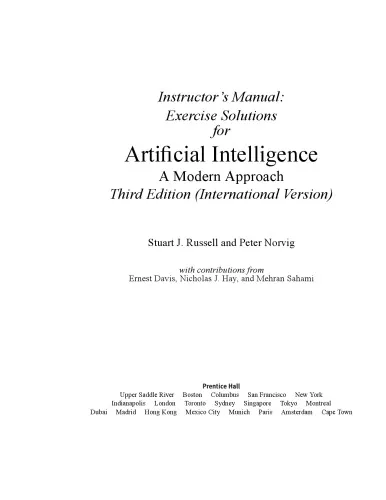
Instructor’s Manual: Exercise Solutions for Artificial Intelligence A Modern Approach - Third Edition
Stuart J. RussellandPeter Norvig
2010
View book
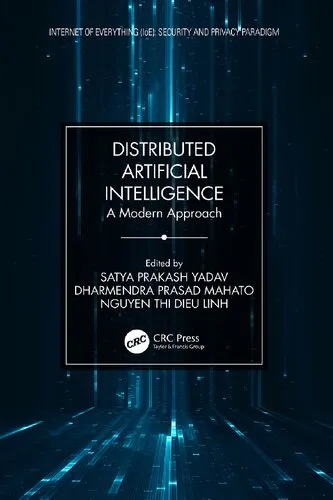
Distributed Artificial Intelligence: A Modern Approach
Satya Prakash Yadav (editor),Dharmendra Prasad Mahato (editor),Nguyen Thi Dieu Linh (editor)
2021
View book