Book guide and evaluation
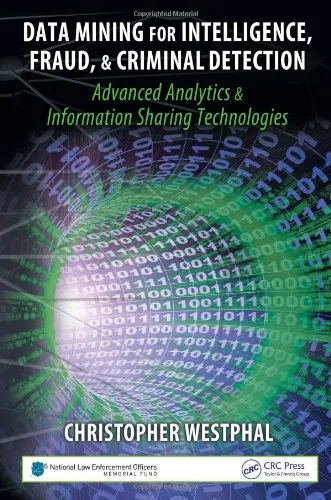
Data Mining for Intelligence, Fraud & Criminal Detection: Advanced Analytics & Information Sharing Technologies
Christopher Westphal
English
Unordered
Software Engineering
4.1 / 5
0 reviews
2008
Published
450
pages
235
views
Introduction to 'Data Mining for Intelligence, Fraud & Criminal Detection' Welcome to 'Data Mining for Intelligence, Fraud & Criminal Detection: Advanced Analytics & Information Sharing Technologies,' a groundbreaking exploration of leveraging modern analytics frameworks
Before you read
What will you get from this book?
Introduction to 'Data Mining for Intelligence, Fraud & Criminal Detection'
Welcome to 'Data Mining for Intelligence, Fraud & Criminal Detection: Advanced Analytics & Information Sharing Technologies,' a groundbreaking exploration of leveraging modern analytics frameworks to address critical challenges in security, fraud prevention, and criminal detection. Authored by Christopher Westphal, this book unveils transformative methodologies to navigate the complexities of data-driven intelligence, rooted in real-world applications.
In today's hyper-connected world, the ability to detect patterns, trends, and anomalies in vast datasets has become a cornerstone for organizations tasked with safeguarding society against fraud and crime. This book offers both theoretical insights and practical, actionable solutions for professionals in law enforcement, cybersecurity, financial services, and other sensitive domains. Through advanced analytics and information-sharing technologies, readers are guided on how to harness the power of data mining while addressing technical, ethical, and operational challenges.
Detailed Summary of the Book
The book begins by establishing the fundamental importance of data mining in the realms of intelligence and fraud detection. It provides a comprehensive overview of the tools and techniques used to turn raw data into actionable intelligence, highlighting their applications in law enforcement, government agencies, and private sector organizations. Topics such as pattern recognition, anomaly detection, predictive modeling, and network analysis are discussed in-depth.
Christopher Westphal also emphasizes the importance of data sharing across organizations, which has traditionally been hindered by bureaucratic barriers and technological incompatibilities. The book proposes frameworks for seamless information sharing while maintaining the confidentiality and security of sensitive data. Case studies throughout the book illustrate successful implementations of advanced analytics in combating fraud and crime, including detecting money laundering schemes, cyber threats, and organized crime networks.
Readers are introduced to the ethical considerations surrounding data mining and the potential for misuse of analytical tools. The book does not shy away from addressing the delicate balance between privacy and security, urging professionals to act in a socially responsible manner. Each chapter equips readers with practical expertise, ranging from selecting the right analytical tools to interpreting complex data outputs correctly.
Key Takeaways
- Understand the foundational concepts of data mining and analytics tools used for intelligence gathering and fraud detection.
- Learn how to identify patterns, anomalies, and predictive indicators in complex datasets.
- Explore frameworks for inter-organizational information sharing, enhancing collaboration while protecting sensitive data.
- Dive into real-world case studies that exemplify the role of analytics in combating criminal networks and financial fraud.
- Gain insights into the ethical challenges inherent in data mining and the balance between privacy and security.
- Access practical strategies for overcoming operational challenges in implementing data-driven solutions.
Famous Quotes from the Book
"In a world awash with data, the ability to separate signal from noise defines the success of intelligence efforts." - Christopher Westphal
"Fraud is not a static crime; it evolves alongside technology. The tools we use to detect it must evolve even faster." - Christopher Westphal
"Effective information sharing isn’t just an option; it’s a necessity to combat global criminal networks." - Christopher Westphal
Why This Book Matters
This book serves as a vital resource in the age of information overload, where uncovering critical insights from data can mean the difference between success and failure in protecting assets, lives, and institutions. With the proliferation of fraud and cybercrime, professionals need refined tools and strategies to stay ahead of sophisticated threats.
Beyond its technical rigor, the book provides actionable guidance for bridging organizational divides and fostering collaboration to address shared risks. It empowers readers to tackle complex intelligence challenges ethically and effectively while embracing innovation and collaboration in their workflows.
Whether you're a data scientist, law enforcement officer, analyst, or policymaker, 'Data Mining for Intelligence, Fraud & Criminal Detection' offers valuable knowledge for navigating the ever-changing landscape of criminal and fraud detection through advanced analytics.
Ask this book
Your question is answered in the context of this title and author. Each answer uses 2 points.
Sign in to ask the book assistant.
Reader reviews
0 reviews, 4.1 average out of 5
No reviews yet
If you have read this book, help the next reader with your experience.
Write a review
Sign in to publish a review.
Reader questions and answers
Ask a focused question and learn from the community.
Sign in to ask or answer a question.
No questions yet
Be the first to ask a clear, useful question.
What to read next
Related references that continue this learning path.
Solutions Architect's Handbook: Kick-start your career as a solutions architect by learning architecture design principles and strategies, 2nd Edition
Saurabh Shrivastava,Neelanjali Srivastav
2022
View book
Solutions Architect's Handbook - Third Edition: Kick-start your career with architecture design principles, strategies, and generative AI techniques
Saurabh Shrivastava,Neelanjali Srivastav
2024
View book