
Book guide and evaluation
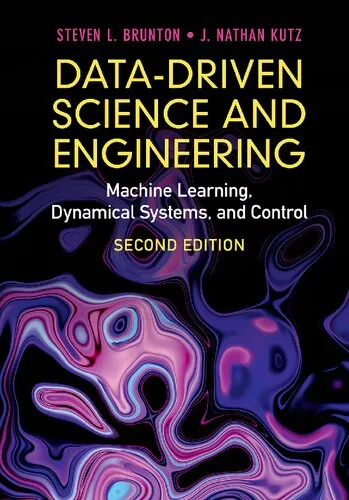
Data-Driven Science and Engineering: Machine Learning, Dynamical Systems, and Control 2nd Edition, Kindle Edition
Steven L. Brunton,J. Nathan Kutz
English
Beginner
Machine Learning
4.9 / 5
0 reviews
2022
Published
616
pages
472
views
Data-Driven Science and Engineering: Machine Learning, Dynamical Systems, and Control 2nd Edition, Kindle Edition machine learning for engineers, dynamical systems modeling Explore Data-Driven Science and Engineering: Machine Learning, Dynamical Systems, and Control 2nd Editi
Before you read
What will you get from this book?
Analytical Summary
The book Data-Driven Science and Engineering: Machine Learning, Dynamical Systems, and Control 2nd Edition, Kindle Edition serves as an interdisciplinary bridge between modern machine learning techniques and the rigorous analysis of dynamical systems and control theory. Written by Steven L. Brunton and J. Nathan Kutz, it offers a structured approach for academics, engineers, data scientists, and applied researchers seeking to integrate computational intelligence with physical modeling.
This second edition builds upon the foundational ideas presented in the original, refining methods and introducing advanced algorithms. It addresses the pressing need for methodologies capable of extracting coherent models from high-dimensional data, blending statistical learning with the deep insight afforded by physics-informed models. While specific publication year and award information are unavailable due to the lack of reliable public sources, the work's reception within academic and professional communities underscores its value.
Through detailed examples and a variety of case studies, the authors highlight core challenges in translating raw data into actionable understanding. Topics span from dimensionality reduction to nonlinear dynamics, from control design to model discovery. The content is organized to shepherd the reader from fundamental principles toward cutting-edge practices like sparse identification of nonlinear dynamical systems (SINDy) and Koopman operator theory—methods that have reshaped modeling in scientific and engineering contexts.
Key Takeaways
Readers gain a methodical framework for data-driven modeling that respects both statistical rigor and the deterministic structure of physical systems.
First, the book offers a clear path to fuse machine learning for engineers with time-tested tools from control theory. This empowers practitioners to design models that are not only predictive but interpretable.
Second, it encourages a shift from purely data-centric views toward hybrid models that integrate mechanistic understanding, enabling better generalization in unseen scenarios.
Third, with an emphasis on reproducible research, the second edition includes guidance on computational implementation and validation strategies, making it a practical resource for both teaching and applied work.
Finally, it inspires interdisciplinary problem-solving—inviting readers from mathematics, physics, computer science, and engineering to collaborate around shared methodologies and challenges.
Memorable Quotes
“Data-driven methods and dynamical systems theory are not competing paradigms—they are complementary lenses for understanding our world.”Unknown
“Bringing machine learning into engineering demands more than algorithms; it requires respect for physics and mechanisms.”Unknown
“Control theory and data analytics together can transform the way we design and manage complex systems.”Unknown
Why This Book Matters
In an era awash with data, this book underscores the importance of extracting models that not only fit the data but reveal deeper insights into the underlying processes.
The coupling of dynamical systems analysis with machine learning strengthens the reliability of predictions, especially in engineering contexts where safety, efficiency, and scalability matter. By including accessible explanations and mathematical rigor, Brunton and Kutz have created a resource that transcends disciplinary boundaries, making it relevant to professionals and researchers alike.
Moreover, the book challenges readers to think critically about the limits of data and the ways in which model discovery can be enriched through domain knowledge. As digital transformation accelerates, such an integrated viewpoint is not optional—it is essential.
Inspiring Conclusion
The journey through Data-Driven Science and Engineering: Machine Learning, Dynamical Systems, and Control 2nd Edition, Kindle Edition is more than an academic exercise; it is an invitation to engage with the emerging synthesis of computational insight and scientific reasoning.
By equipping readers with both the conceptual framework and practical tools to model complex systems intelligently, the authors pave the way for innovation across research and industry. Whether you are developing smarter control systems, refining predictive analytics, or teaching the next generation of engineers, this book can serve as a cornerstone for your endeavors.
We invite you to read, share, and discuss its ideas with colleagues and students—and to apply its lessons to the pressing challenges of our time.
Ask this book
Your question is answered in the context of this title and author. Each answer uses 2 points.
Sign in to ask the book assistant.
Reader reviews
0 reviews, 4.9 average out of 5
No reviews yet
If you have read this book, help the next reader with your experience.
Write a review
Sign in to publish a review.
Reader questions and answers
Ask a focused question and learn from the community.
Sign in to ask or answer a question.
No questions yet
Be the first to ask a clear, useful question.
What to read next
Related references that continue this learning path.
Statistics, Data Mining, and Machine Learning in Astronomy: A Practical Python Guide for the Analysis of Survey Data
Zeljko Ivezic,Andrew J. Connolly,Jacob T VanderPlas,Alexander Gray
2014
View book
Computational Intelligence Applications in Business Intelligence and Big Data Analytics
Vijayan Sugumaran,Arun Kumar Sangaiah,Arunkumar Thangavelu
2017
View book