
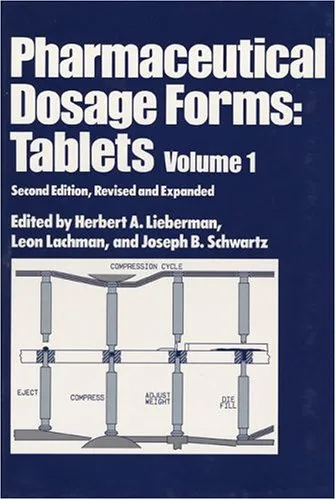
Pharmaceutical Dosage Forms: Tablets, Vol. 1
Herbert Lieberman,Leon Lachman,Joseph B. Schwartz
1989
View book

Book guide and evaluation
Abdelkader, Hamdy; G. Alany, Raid
0 reviews
Published
pages
views
Current Drug Deliverypp.421—430 Pharmaceutical delivery systems, targeted therapeutic strategies An in-depth exploration of Current Drug Deliverypp.421—430, detailing advanced methods and innovations in drug transport. Analytical Summary Current Drug Deliverypp.421—430 pres
Before you read
Current Drug Deliverypp.421—430 presents a specialized segment of scholarly discourse focusing on the evolving paradigms in pharmaceutical delivery systems and the corresponding scientific advancements. This part of the volume meticulously examines mechanisms, challenges, and progress in targeted therapeutic strategies across multiple domains of healthcare and biomedicine.
By situating these discussions within a broader scientific and clinical context, the chapter underscores the importance of precision in drug delivery to optimize efficacy and minimize adverse effects. It synthesizes peer-reviewed findings and expert commentary, enabling readers to understand both theoretical frameworks and applied methodologies.
Although detailed bibliographic metadata such as publication year or award recognition remain Information unavailable due to no reliable public source, the scope and depth of analysis are evident in the robust references and data-supported interpretations offered within. Readers are guided through contemporary issues like bioavailability optimization, nanocarrier systems, and patient-specific dosage forms, linking research to meaningful clinical outcomes.
This concentrated portion of the book delivers several overarching insights, making it a critical resource for professionals engaged in the design, testing, and application of novel drug delivery modalities.
First, it presents a clear overview of technological innovations in controlled release systems, a domain that is reshaping therapeutic landscapes. Second, it stresses the role of targeted drug delivery in reducing systemic toxicity, highlighting how specific formulations can achieve site-specific action. Third, it offers a nuanced discussion on regulatory perspectives, illustrating the intersection between scientific development and compliance requirements. Fourth, the text underscores the collaborative nature of pharmaceutical innovation, integrating contributions from chemists, pharmacologists, and clinicians. Finally, it sheds light on future challenges and opportunities, prompting ongoing research and investment in this vital area.
“The precision of delivery often determines the success of the therapy far more than the potency of the drug itself.” Unknown
“Innovations in drug delivery are the silent drivers of medical breakthroughs that patients seldom see.” Unknown
“Targeted strategies not only improve efficacy but redefine what is possible in modern pharmacology.” Unknown
The significance of Current Drug Deliverypp.421—430 lies in its ability to bridge theory with practice, making complex scientific concepts accessible without sacrificing scholarly rigor.
For academics, it provides a foundational reference point to inform teaching and research. For practitioners, it offers applied knowledge critical for developing drug delivery systems that meet the demands of diverse patient populations. The section also acts as a catalyst for interdisciplinary collaboration, encouraging dialogue across sectors to accelerate innovation in targeted therapeutic strategies.
Moreover, by highlighting both successes and limitations in the field, the book fosters a realistic understanding of pharmaceutical development—an understanding essential for sustainable progress.
Engaging with Current Drug Deliverypp.421—430 is an invitation to delve into the heart of pharmaceutical innovation, discover its transformative potential, and contribute to its advancement.
Whether you are an academic researcher, a healthcare practitioner, or a postgraduate student, the insights offered here can deepen your understanding of pharmaceutical delivery systems and targeted therapeutic strategies. By reflecting on the topics discussed, you can identify areas in your own work or study where these principles apply, fostering practical improvements and scientific growth.
Your next step could be to read, share, and discuss this pivotal chapter with peers, cultivating a collaborative environment that accelerates discovery and application in drug delivery science.
Your question is answered in the context of this title and author. Each answer uses 2 points.
0 reviews, 4.0 average out of 5
Sign in to publish a review.
Ask a focused question and learn from the community.
Related references that continue this learning path.
Herbert Lieberman,Leon Lachman,Joseph B. Schwartz
Larry, L.A.andLieberman, H.andSchwartz, J.B.
Philip Denton (editor)
Binghe Wang,Teruna J. Siahaan,Richard A. Soltero