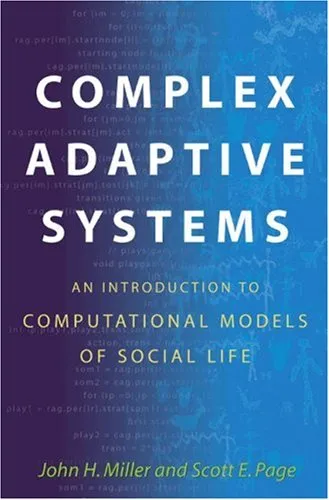
Complex Adaptive Systems: An Introduction to Computational Models of Social Life (Princeton Studies in Complexity)
John H. Miller,Scott E. Page
2007
View book
Book guide and evaluation
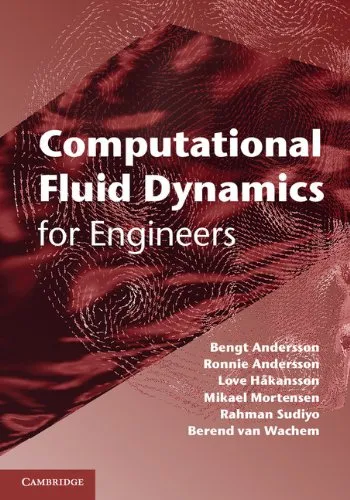
Bengt Andersson,Ronnie Andersson,Love Håkansson,Mikael Mortensen,Rahman Sudiyo,Berend van Wachem
0 reviews
Published
pages
views
Introduction to "Computational Fluid Dynamics for Engineers" "Computational Fluid Dynamics for Engineers" is a comprehensive guide crafted to serve as an essential resource for engineers and students who want to delve into the fascinating world of fluid dynamics. The book
Before you read
"Computational Fluid Dynamics for Engineers" is a comprehensive guide crafted to serve as an essential resource for engineers and students who want to delve into the fascinating world of fluid dynamics. The book brings together theoretical foundations, practical applications, and contemporary methodologies to provide a balanced and insightful take on computational fluid dynamics (CFD). Designed with clarity and accessibility in mind, this book is an indispensable companion for anyone seeking to master computational techniques for solving fluid flow problems.
The book is meticulously structured for engineers who aim to understand the basics as well as tackle advanced topics in computational fluid dynamics. It begins with an intuitive introduction to the fundamentals of fluid mechanics and the governing equations that describe fluid behavior, such as the Navier-Stokes equations. From these fundamental equations, the book details mathematical and numerical techniques that are central to CFD, ensuring a strong foundational understanding.
Following the theoretical groundwork, the book takes readers step-by-step through numerical strategies like finite difference, finite volume, and finite element methods. Each approach is explained with clarity, illustrated by practical examples to help readers understand how these methods work in real-world applications. All examples have been chosen carefully to provide relevance for engineers in industries such as aerospace, automotive, civil engineering, and environmental science.
Recognizing the importance of modern tools, the book integrates discussions about software and programming practices used in CFD. It offers practical advice on setting up simulations, solving complex cases, and interpreting results effectively. Coverage of turbulence modeling, heat transfer, and multi-phase flow ensures that the reader obtains a holistic understanding of CFD applications.
Throughout all chapters, the focus remains on bridging the gap between theory and practice. The book emphasizes hands-on problem solving and develops essential skills in deriving, coding, and validating CFD models. Readers will leave with the confidence to apply their skills in both academic research and industrial contexts.
"CFD is an art as much as it is a science—developing an effective model requires not only knowledge of mathematical principles but also intuition and creativity."
"The power of computational fluid dynamics lies not in its ability to give us answers, but in its potential to reveal deeper questions about the physics of fluid flows."
"To master CFD, one must cultivate patience—numerical algorithms take time to develop, and real-world insights emerge only through careful iteration."
"Computational Fluid Dynamics for Engineers" stands out as an invaluable resource because it bridges theoretical rigor with practical utility. Whether you are a student beginning your journey in fluid dynamics or an experienced engineer seeking to deepen your knowledge, this book offers insights that are both educational and inspirational.
The engineering world is increasingly relying on CFD to address critical challenges, from predicting airflow in complex geometries to optimizing energy efficiency in industrial processes. By focusing on practical skill development and interdisciplinary applications, the book equips readers with the tools needed to remain competitive and innovative in their fields.
Moreover, this book is written by a team of renowned experts in the field, whose collective experience ensures a balanced and authoritative treatment of the subject. The authors’ passion for CFD shines through in each chapter, making technical concepts enjoyable and accessible. For anyone looking to harness the capabilities of CFD and push the boundaries of engineering, this book offers all the guidance needed to excel.
Your question is answered in the context of this title and author. Each answer uses 2 points.
0 reviews, 4.5 average out of 5
Sign in to publish a review.
Ask a focused question and learn from the community.
Related references that continue this learning path.
John H. Miller,Scott E. Page