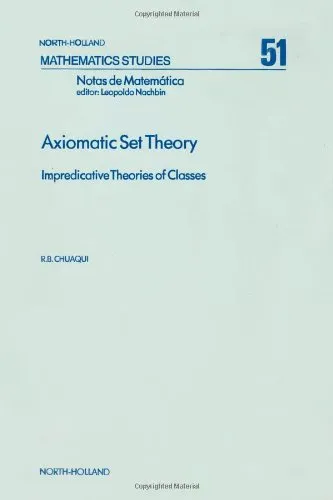
Axiomatic Set Theory: Theory Impredicative Theories of Classes
Leopoldo Nachbin (Eds.)
1981
View book
Book guide and evaluation
Herbert B. Enderton
0 reviews
Published
pages
views
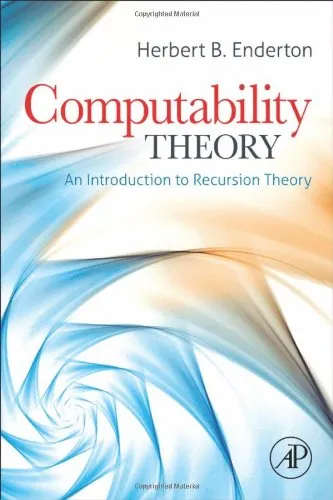
Introduction to 'Computability Theory: An Introduction to Recursion Theory' Computability Theory: An Introduction to Recursion Theory offers a comprehensive exploration into the enigmatic realm of computability and recursion. Authored by Herbert B. Enderton, the book is a
Before you read
Computability Theory: An Introduction to Recursion Theory offers a comprehensive exploration into the enigmatic realm of computability and recursion. Authored by Herbert B. Enderton, the book is a preeminent resource for both students and scholars who seek a deeper understanding of the theoretical underpinnings that have shaped modern computational paradigms.
Enderton's Computability Theory begins with a foundational discussion on the concepts of algorithms and effective calculability, setting the stage for a methodical examination of formal systems and computation models. The text intricately unravels the constructs of mathematical logic and the decisive role they play in computability.
The book systematically approaches key topics such as Turing machines, recursive functions, and the Church-Turing thesis. With precise and accessible language, Enderton elucidates complex ideas, ensuring that readers gradually build an intuitive understanding. Moving beyond the basics, the text delves into more advanced subjects like degrees of unsolvability, the recursion theorem, and cardinality considerations in the context of effective procedures.
Enderton's work distinctly stands out due to its balanced blend of theory and application. The numerous examples, exercises, and illustrative proofs throughout the book not only reinforce the theoretical discourse but also offer practical insight into real-world computational challenges. This careful integration of content ensures that readers are well-prepared to apply these theoretical constructs in varied contexts.
"In computing, the simplicity of a Turing machine belies the immense capability it conveys, a testament to the power inherent in human ingenuity."
"To comprehend what it means for a function to be computable is to stand on the bridge between mathematical abstraction and practical computation."
Herbert B. Enderton's work is pivotal in the landscape of theoretical computer science. In an era where computational rigor consistently challenges and inspires modern technological advancement, Computability Theory provides an essential framework for understanding the logical structure of problems and tasks that computers tackle.
The book is particularly crucial for those involved in the fields of computer science, mathematics, and logic, as it provides the tools necessary to explore and demystify computational boundaries. Beyond academia, the implications of these ideas steer many practical applications, from developing algorithms designed to optimize processes, to exploring the limits of artificial intelligence.
In essence, this book is not just a scholarly resource but a bridge that connects theoretical paradigms with tangible, impactful outcomes in the real world. As the digital age progresses, understanding the realms delineated by recursion theory and computability becomes ever more consequential.
Whether you are an aspiring mathematician, a computer scientist, or simply a curious intellectual, Computability Theory: An Introduction to Recursion Theory will serve as an invaluable companion in your intellectual pursuits. Dive into the philosophical and practical dimensions of computability with this expertly crafted guide.
Your question is answered in the context of this title and author. Each answer uses 2 points.
0 reviews, 4.5 average out of 5
Sign in to publish a review.
Ask a focused question and learn from the community.
Related references that continue this learning path.
Leopoldo Nachbin (Eds.)
Charles M. Quinn