

Design and Analysis of Approximation Algorithms
Ding-Zhu Du,Ker-I Ko,Xiaodong Hu (auth.)
2012
View book
Book guide and evaluation
Zhu Han,Husheng Li,Wotao Yin
0 reviews
Published
pages
views
Introduction to "Compressive Sensing for Wireless Networks" "Compressive Sensing for Wireless Networks" is a seminal work that brings forth a revolutionary approach to handling data in wireless networks. With the explosive growth of data traffic, traditional methodologies
Before you read
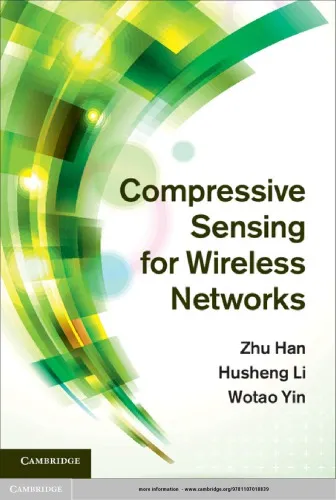
"Compressive Sensing for Wireless Networks" is a seminal work that brings forth a revolutionary approach to handling data in wireless networks. With the explosive growth of data traffic, traditional methodologies are often found inadequate. This book bridges this gap by employing the powerful mathematical paradigm of compressive sensing — a technique that allows the reconstruction of signals with far fewer samples than traditional methods require. Ideal for researchers, engineers, and practitioners, this book explores cutting-edge theories and real-world applications, providing a deep dive into both foundational principles and advanced topics.
The book is organized into comprehensive chapters that guide the reader from the basics to advanced concepts of compressive sensing in wireless environments. Initially, it discusses the limitations of classic data acquisition techniques, emphasizing their inefficiencies in high-dimensional settings. By introducing the principles of compressive sensing, the book underlines its potential in overcoming these challenges by leveraging sparsity in data representation.
Moving forward, the text delves into key algorithms, such as Basis Pursuit, Orthogonal Matching Pursuit, and CoSaMP, each meticulously explained with mathematical rigor. It progresses to cover their application in channel estimation, data compression, and energy-efficient communications, highlighting their efficacy in boosting network performance and reducing latency.
The latter sections of the book consider practical implementations, providing case studies and examples where compressive sensing has successfully optimized wireless systems. This includes network monitoring, spectrum sensing, and collaborative sensor networks, all of which illustrate the full breadth of its applicability.
"In an era where data is the new oil, efficiently processing and transmitting this data is paramount for any wireless technology."
"Compressive sensing is not just a theoretical breakthrough; it’s a transformative tool enabling us to rethink how we design, implement, and enhance wireless networks."
This book is instrumental in equipping the reader with both the theoretical foundation and practical insights needed to harness compressive sensing in modern wireless technologies. As the demand for data continues to surge, the methodologies covered in this volume offer critical solutions to overcome bandwidth constraints and enhance signal processing efficiency. By providing a versatile framework, the book facilitates the development of smarter, faster, and more scalable wireless networks.
Beyond its academic and technical contributions, "Compressive Sensing for Wireless Networks" fosters innovation by challenging readers to think beyond the conventional paradigms, inspiring the next generation of solutions in the wireless domain. As such, it is a critical resource for anyone involved in the design and implementation of wireless systems, from seasoned engineers to forward-thinking network developers.
Your question is answered in the context of this title and author. Each answer uses 2 points.
0 reviews, 4.0 average out of 5
Sign in to publish a review.
Ask a focused question and learn from the community.
Related references that continue this learning path.
Ding-Zhu Du,Ker-I Ko,Xiaodong Hu (auth.)

Daan Frenkel;Berend Smit


Mourad Baïou,Francisco Barahona (auth.),William Cook,László Lovász,Jens Vygen (eds.)