Book guide and evaluation
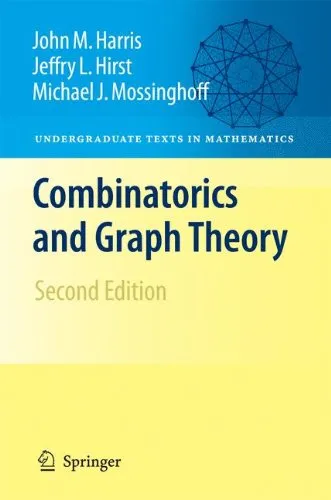
Combinatorics and Graph Theory
John Harris,Jeffry L. Hirst,Michael Mossinghoff (auth.)
English
Beginner
Mathematics
4.5 / 5
0 reviews
2008
Published
391
pages
717
views
Introduction to "Combinatorics and Graph Theory" Welcome to the immersive world of "Combinatorics and Graph Theory", a comprehensive guide crafted by John Harris, Jeffry L. Hirst, and Michael Mossinghoff. This book serves as a cornerstone for those venturing into t
Before you read
What will you get from this book?
Introduction to "Combinatorics and Graph Theory"
Welcome to the immersive world of "Combinatorics and Graph Theory", a comprehensive guide crafted by John Harris, Jeffry L. Hirst, and Michael Mossinghoff. This book serves as a cornerstone for those venturing into the intricacies of combinatorial mathematics and graphical analysis, used extensively in various fields such as computer science, operations research, and applied mathematics.
Detailed Summary of the Book
"Combinatorics and Graph Theory" is a meticulously structured textbook that delves deep into the foundational concepts and theories of combinatorics and graph theory. The book is designed for both beginners and seasoned mathematicians, offering insights that cater to a wide array of audiences. The initial chapters introduce the basic tenets of combinatorial mathematics, including permutations, combinations, and fundamental counting techniques. As readers progress, the text guides them through complex topics like generating functions, recurrence relations, and the principle of inclusion-exclusion.
In the latter half, the book transitions into the realm of graph theory, exploring the properties and applications of graphs. Through detailed explanations and examples, readers learn about graph connectivity, Euler circuits, Hamiltonian paths, and graph coloring. Additionally, the book includes sections devoted to network flows, planarity, and trees, each enriched with rigorous proofs and practical applications.
Throughout the chapters, numerous exercises challenge the reader’s understanding and application of underlying concepts, ensuring a robust grasp of the material. With its systematic approach and comprehensive coverage, the book stands as an essential resource for those aspiring to excel in mathematics and related disciplines.
Key Takeaways
- A thorough understanding of fundamental combinatorial principles.
- Insight into the structure and functions of various types of graphs.
- Proficiency in mathematical reasoning and proof strategies related to graph theory.
- Tools and techniques for solving complex problems in discrete mathematics.
Famous Quotes from the Book
"Combinatorics is an art of finding structure in discrete objects; it is as much about creating as it is about solving."
"In graph theory, we face endless possibilities and challenges. Every graph tells a story, and every problem has a multitude of solutions waiting to be discovered."
Why This Book Matters
"Combinatorics and Graph Theory" addresses the growing demand for mathematical frameworks essential in today’s technology-driven society. As algorithms and computational models become increasingly critical in virtually every industry, understanding the underlying mathematics is paramount. This book not only equips readers with the necessary theoretical background but also encourages analytical problem-solving skills crucial for innovation and technological advancements.
The depth and breadth of topics covered ensure that the book remains a timeless resource in the field of mathematics and beyond. By seamlessly blending theoretical narratives with applied techniques, it prepares readers to tackle real-world challenges with confidence and creativity.
With its clear exposition, "Combinatorics and Graph Theory" is more than just a textbook; it's a journey into the elegance of mathematics, offering readers the tools to unlock the secrets of complex systems and networks.
Ask this book
Your question is answered in the context of this title and author. Each answer uses 2 points.
Sign in to ask the book assistant.
Reader reviews
0 reviews, 4.5 average out of 5
No reviews yet
If you have read this book, help the next reader with your experience.
Write a review
Sign in to publish a review.
Reader questions and answers
Ask a focused question and learn from the community.
Sign in to ask or answer a question.
No questions yet
Be the first to ask a clear, useful question.
What to read next
Related references that continue this learning path.
Robert of Chester’s (?) Redaction of Euclid’s Elements, the so-called Adelard II Version: Volume II
Dr. Hubert L. L. Busard,Prof. Dr. Menso Folkerts (auth.)
1992
View book
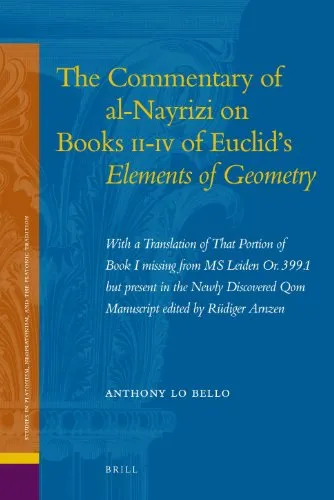
The Commentary of al-Nayrizi on Books II-IV of Euclid's Elements of Geometry
Anthony Lo Bello
2009
View book