

Book guide and evaluation
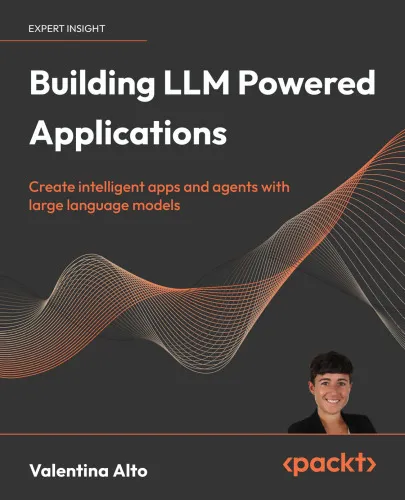
Building LLM Powered Applications: Create intelligent apps and agents with large language models
Valentina Alto
English
Unordered
Unordered
4.9 / 5
0 reviews
2024
Published
343 / 343
pages
107
views
Get hands-on with GPT 3.5, GPT 4, LangChain, Llama 2, Falcon LLM and more, to build LLM-powered sophisticated AI applications Key FeaturesEmbed LLMs into real-world applicationsUse LangChain to orchestrate LLMs and their components within applicationsGrasp basic and advanced tech
Before you read
What will you get from this book?
Get hands-on with GPT 3.5, GPT 4, LangChain, Llama 2, Falcon LLM and more, to build LLM-powered sophisticated AI applications Key FeaturesEmbed LLMs into real-world applicationsUse LangChain to orchestrate LLMs and their components within applicationsGrasp basic and advanced techniques of prompt engineeringBook DescriptionBuilding LLM Powered Applications delves into the fundamental concepts, cutting-edge technologies, and practical applications that LLMs offer, ultimately paving the way for the emergence of large foundation models (LFMs) that extend the boundaries of AI capabilities. The book begins with an in-depth introduction to LLMs. We then explore various mainstream architectural frameworks, including both proprietary models (GPT 3.5/4) and open-source models (Falcon LLM), and analyze their unique strengths and differences. Moving ahead, with a focus on the Python-based, lightweight framework called LangChain, we guide you through the process of creating[...]intelligent agents capable of retrieving information from unstructured data and engaging with structured data using LLMs and powerful toolkits. Furthermore, the book ventures into the realm of LFMs, which transcend language modeling to encompass various AI tasks and modalities, such as vision and audio. Whether you are a seasoned AI expert or a newcomer to the field, this book is your roadmap to unlock the full potential of LLMs and forge a new era of intelligent machines.What you will learnExplore the core components of LLM architecture, including encoder-decoder blocks and embeddingsUnderstand the unique features of LLMs like GPT-3.5/4, Llama 2, and Falcon LLMUse AI orchestrators like LangChain, with Streamlit for the frontendGet familiar with LLM components such as memory, prompts, and toolsLearn how to use non-parametric knowledge and vector databasesUnderstand the implications of LFMs for AI research and industry applicationsCustomize your LLMs with fine tuningLearn about the ethical implications of LLM-powered applicationsWho this book is for Software engineers and data scientists who want hands-on guidance for applying LLMs to build applications. The book will also appeal to technical leaders, students, and researchers interested in applied LLM topics. We don't assume previous experience with LLM specifically. But readers should have core ML/software engineering fundamentals to understand and apply the content.]]>
Ask this book
Your question is answered in the context of this title and author. Each answer uses 2 points.
Sign in to ask the book assistant.
Reader reviews
0 reviews, 4.9 average out of 5
No reviews yet
If you have read this book, help the next reader with your experience.
Write a review
Sign in to publish a review.
Reader questions and answers
Ask a focused question and learn from the community.
Sign in to ask or answer a question.
No questions yet
Be the first to ask a clear, useful question.
What to read next
Related references that continue this learning path.


Biology of the Fungal Cell
Nicholas P. Money (auth.),Professor Dr. Richard J. Howard,Professor Dr. Neil A. R. Gow (eds.)
2001
View book