
A Study of Husserl's Formal and Transcendental Logic
Suzanne Bachelard. Translated by Lester E. Embree
1990
View book
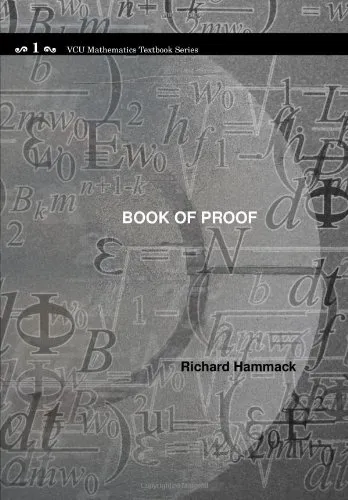
Book guide and evaluation
Richard Hammack
0 reviews
Published
pages
views
Introduction to the Book of Proof The Book of Proof is a comprehensive and accessible primer in the realm of mathematical proof and logic, designed for anyone who seeks to delve into the foundational aspects of mathematics. Written by Richard Hammack, this book is widely r
Before you read
The Book of Proof is a comprehensive and accessible primer in the realm of mathematical proof and logic, designed for anyone who seeks to delve into the foundational aspects of mathematics. Written by Richard Hammack, this book is widely regarded as a must-read for students transitioning from calculus and other computational math courses to the elegant, logic-driven world of higher mathematics. With clear explanations, step-by-step examples, and a focus on rigor, the Book of Proof equips readers with the tools to navigate the abstract landscape of mathematical theory.
Whether you are a student, an instructor, or a math enthusiast, this book will help you build a solid understanding of proof techniques and logical reasoning. It introduces key concepts like sets, logic, functions, and relations while exploring advanced topics such as induction, modular arithmetic, and cardinality. Its approachable writing style and structured progression provide both clarity and challenge.
The Book of Proof begins by addressing fundamental topics such as the structure of mathematical arguments, truth tables, and logical connectives, creating an essential foundation for understanding proofs. It progresses to explore sets, including unions, intersections, and subsets, laying the groundwork for further algebraic and geometric explorations.
Moving deeper into the material, readers encounter the methodologies behind writing proofs, such as direct proofs, proof by contrapositive, proof by contradiction, and proof by induction. Each proof technique is illustrated with carefully crafted, progressively challenging examples that guide the reader from basic to advanced applications. Along the way, readers learn to write elegant and concise proofs while sharpening their ability to think abstractly.
Later chapters delve into advanced topics like equivalence relations, functions, cardinality, and the properties of infinite sets. These chapters provide a bridge to abstract algebra and real analysis while ensuring the reader is fully equipped with the skills to tackle further studies in mathematics. The book's final chapters touch on number theory concepts, such as modular arithmetic and divisibility, offering a taste of the vast connections within mathematics.
"Mathematics is built upon the simple yet profound idea of logical reasoning. Learning it is akin to learning a new language of thought."
"A mathematical proof is a chain of reasoning, grounded in facts, that leads inexorably to a conclusion."
"The beauty of mathematical proof lies in its simplicity, its elegance, and its power to convey absolute certainty."
The Book of Proof is more than just a textbook; it's a gateway into the rigorous and imaginative world of mathematics. For students making the leap from computational, application-driven mathematics to theoretical study, this book is an invaluable resource. It demystifies the abstract nature of proofs and logic, making them approachable without sacrificing rigor or breadth.
What makes this book truly stand out is its clear and engaging writing style, where every concept is broken down systematically but not at the expense of intellectual challenge. The carefully chosen examples and exercises are designed to solidify understanding while fostering a sense of curiosity and discovery. Its adaptability as a classroom text or a self-study resource makes it accessible to a wide audience.
In a world where logical problem-solving is increasingly important, the Book of Proof equips readers with the skills and mindset needed to approach not only mathematics but also challenges in engineering, computer science, philosophy, and other disciplines. It serves as an uncompromising reminder of mathematics' role as both a practical tool and a profound art form.
Your question is answered in the context of this title and author. Each answer uses 2 points.
0 reviews, 4.7 average out of 5
Sign in to publish a review.
Ask a focused question and learn from the community.
Related references that continue this learning path.
Suzanne Bachelard. Translated by Lester E. Embree
Dobrzeniecki,Marek
Alan Hausman,Howard Kahane,Paul Tidman