Loading
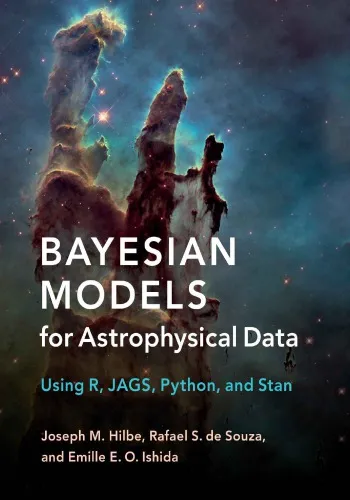
Cover of Bayesian Models for Astrophysical Data: Using R, JAGS, Python, and Stan
English Beginner Artificial Intelligence (AI)

Bayesian Models for Astrophysical Data: Using R, JAGS, Python, and Stan

Joseph M. Hilbe,Rafael S. de Souza,Emille E. O. Ishida

Emille E. O. Ishida

4.6 / 5

0 reviews

2017

Published

384

pages

387

views

This comprehensive guide to Bayesian methods in astronomy enables hands-on work by supplying complete R, JAGS, Python, and Stan code, to use directly or to adapt. It begins by examining the normal model from both frequentist and Bayesian perspectives and then progresses to a full

About this book

This comprehensive guide to Bayesian methods in astronomy enables hands-on work by supplying complete R, JAGS, Python, and Stan code, to use directly or to adapt. It begins by examining the normal model from both frequentist and Bayesian perspectives and then progresses to a full range of Bayesian generalized linear and mixed or hierarchical models, as well as additional types of models such as ABC and INLA. The book provides code that is largely unavailable elsewhere and includes details on interpreting and evaluating Bayesian models. Initial discussions offer models in synthetic form so that readers can easily adapt them to their own data; later the models are applied to real astronomical data. The consistent focus is on hands-on modeling, analysis of data, and interpretations that address scientific questions. A must-have for astronomers, its concrete approach will also be attractive to researchers in the sciences more generally.

Ask this book

Your question is answered in the context of this title and author. Each answer uses 2 points.

Sign in to ask the book assistant.

Reader reviews

0 reviews · 4.6 average out of 5

No reviews yet

If you have read this book, help the next reader with your experience.

Write a review

Sign in to publish a review.

Reader questions and answers

Ask a focused question and learn from the community.

Sign in to ask or answer a question.

No questions yet

Be the first to ask a clear, useful question.

Related references that continue this learning path.