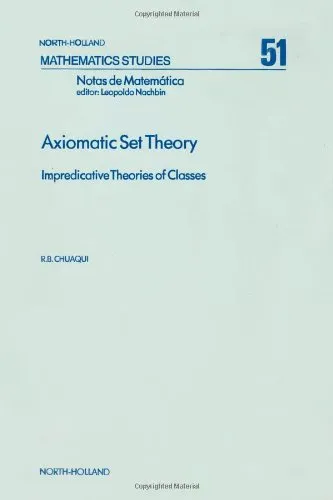
Axiomatic Set Theory: Theory Impredicative Theories of Classes
Leopoldo Nachbin (Eds.)
1981
View book
Book guide and evaluation
Benjamin C. Pierce
0 reviews
Published
pages
views
Introduction to 'Basic Category Theory for Computer Scientists' Welcome to a comprehensive introduction to category theory tailored specifically for computer scientists. 'Basic Category Theory for Computer Scientists' is a seminal work by Benjamin C. Pierce that seeks to bridg
Before you read
Welcome to a comprehensive introduction to category theory tailored specifically for computer scientists. 'Basic Category Theory for Computer Scientists' is a seminal work by Benjamin C. Pierce that seeks to bridge the gap between abstract mathematical concepts and their practical applications in computer science. This introduction will explore the essence of the book, provide key insights, share notable quotes, and discuss the significance of this pioneering work.
'Basic Category Theory for Computer Scientists' delves into the foundational concepts of category theory, an abstract mathematical framework that has profound implications for computer science. The book is structured to gradually build an understanding of categories, functors, natural transformations, and other crucial categorical constructs, presenting them in a way that emphasizes their relevance to computer science.
The book starts with an accessible introduction to categories and morphisms, explaining these concepts through intuitive examples drawn from computer science. As the reader progresses through the chapters, they encounter increasingly sophisticated topics such as limits, colimits, adjunctions, and monads. Each topic is presented with clarity, with illustrations demonstrating their application in areas like programming language semantics, type theory, and information systems.
By the end of the book, readers are equipped not only with a deep understanding of category theory but also with the tools to apply these theoretical insights to practical problems in computer science. This makes 'Basic Category Theory for Computer Scientists' not just an academic text, but a practical guide for software engineers, theoreticians, and researchers alike.
“Category theory is a toolkit for manipulating complex structures with a high degree of abstraction.”
“The beauty of category theory lies in its ability to unify and connect disparate concepts under a single framework.”
“In the realm of computer science, category theory can be seen as a powerful lens leading to new insights and breakthroughs.”
Category theory might seem daunting with its abstract nature, yet it offers a powerful set of ideas and frameworks that profoundly impact computer science. This book matters because it demystifies these complex concepts, presenting them in a context and language that computer scientists can appreciate and leverage.
The strategic intertwining of theory with computer science applications provides readers with not just a theoretical background, but also an appreciation of how these concepts map onto real-world computing problems. In doing so, it empowers computer scientists to tackle challenges with a new, more robust toolkit.
Furthermore, as the software industry increasingly recognizes the importance of mathematical rigor and abstraction, this book prepares practitioners and academics to contribute to this evolving field. Its comprehensive yet accessible approach ensures that both novices and seasoned professionals can enrich their computational knowledge and problem-solving skills.
Your question is answered in the context of this title and author. Each answer uses 2 points.
0 reviews, 4.7 average out of 5
Sign in to publish a review.
Ask a focused question and learn from the community.
Related references that continue this learning path.
Leopoldo Nachbin (Eds.)
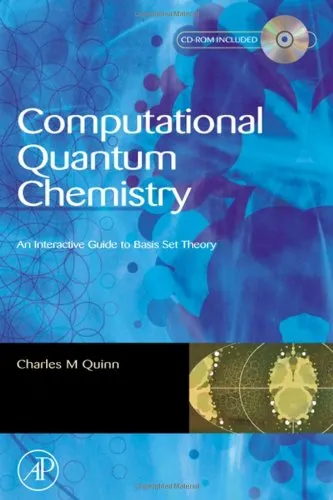
Charles M. Quinn