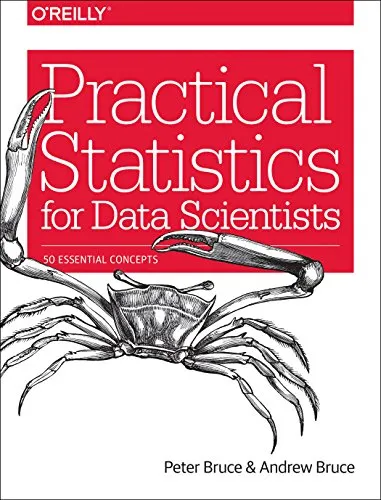
Practical Statistics for Data Scientists: 50 Essential Concepts
Peter Bruce,Andrew Bruce
2017
View book
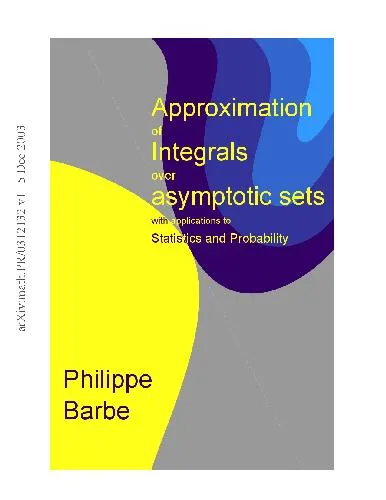
Book guide and evaluation
Barbe P.
0 reviews
Published
pages
views
Introduction to "Approximation of Integrals Over Asymptotic Sets with Applications to Statistics and Probability" "Approximation of Integrals Over Asymptotic Sets with Applications to Statistics and Probability" is a profound exploration of the mathematical intricacies s
Before you read
"Approximation of Integrals Over Asymptotic Sets with Applications to Statistics and Probability" is a profound exploration of the mathematical intricacies surrounding the approximation of complex integrals. Written with both rigor and clarity, this book aims to bridge advanced mathematical theory with practical use cases in statistics and probability. By delving into the theory of asymptotic sets, it provides valuable tools to simplify and evaluate integrals, which appear ubiquitously in statistical modeling and probabilistic frameworks. This text caters to postgraduate students, researchers, and professionals in mathematics, statistics, and related fields who seek a comprehensive understanding of the topic.
The book begins by introducing the mathematical foundations necessary for understanding asymptotic analysis and integral approximations. It builds on classical integration techniques, emphasizing their limitations when tackling high-dimensional or asymptotically defined sets. Through a meticulous development of asymptotic theory, the author provides insights into transforming seemingly intractable integrals into manageable estimations.
One of the core strengths of the book lies in its balance between theory and application. For example, the theoretical exposition of asymptotic sets—mathematical objects characterized by their behavior at infinity—provides the groundwork for solving complex problems in statistics. The text applies these concepts to important topics like maximum likelihood estimation, Bayesian inference, and stochastic processes, making it highly relevant to both theoretical and applied statisticians.
The book is systematically structured to guide the reader from foundational knowledge to advanced applications. Early chapters address fundamental approaches to approximating integrals, including classical techniques like Laplace’s and saddlepoint methods. These chapters provide step-by-step derivations and intuitive explanations of each method. Later chapters extend these discussions to cover multidimensional and infinite-dimensional integration problems, presenting more refined approximation techniques adapted for such cases.
The applications extend across statistics and probability, where the need to compute integrals over complex sets is omnipresent. Whether estimating posterior distributions, calculating probabilities under rare-event scenarios, or evaluating statistical models, the methods outlined in the book offer practical solutions supported by theoretical guarantees. Finally, the book closes with discussions on open problems and potential areas of future research, making it not only a resource for learning but also a springboard for innovation.
"Asymptotic sets provide a lens through which we can view infinity not as a barrier, but as a frontier for discovery."
"The power of approximation lies not just in simplifying complexity, but in unveiling the underlying structures that govern behavior at the extremes."
Integral approximation is a cornerstone of numerous theoretical and applied disciplines. Yet, despite its importance, many standard techniques struggle to cope with the challenges posed by high-dimensional or asymptotic settings. "Approximation of Integrals Over Asymptotic Sets with Applications to Statistics and Probability" addresses this gap with precision and foresight. The book is not merely a collection of methods; it represents a paradigm shift in approaching mathematical integration within modern contexts.
This book matters because it equips researchers and practitioners with the tools to handle problems that were previously deemed intractable. By blending mathematical rigor with real-world examples, it ensures that readers gain both theoretical depth and applied skills. Its relevance extends across multiple domains, including machine learning, econometrics, and actuarial science, where understanding the behavior of complex systems is essential.
Furthermore, the book's emphasis on asymptotic sets introduces a novel perspective on infinity, pushing the boundaries of what is achievable in statistical and probabilistic analysis. By fostering a deeper appreciation for the interplay between mathematics and application, this text stands as a landmark contribution in its field.
Your question is answered in the context of this title and author. Each answer uses 2 points.
0 reviews, 4.0 average out of 5
Sign in to publish a review.
Ask a focused question and learn from the community.
Related references that continue this learning path.
Peter Bruce,Andrew Bruce
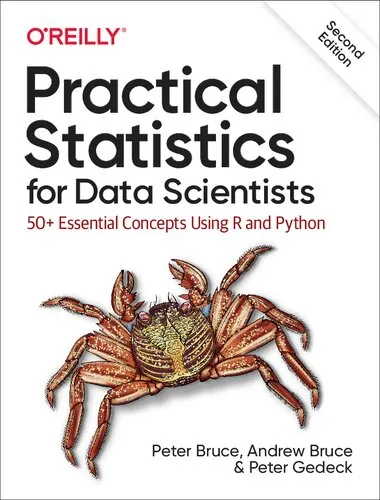
Peter Bruce,Andrew Bruce,Peter Gedeck
Alan Agresti,Christine Franklin