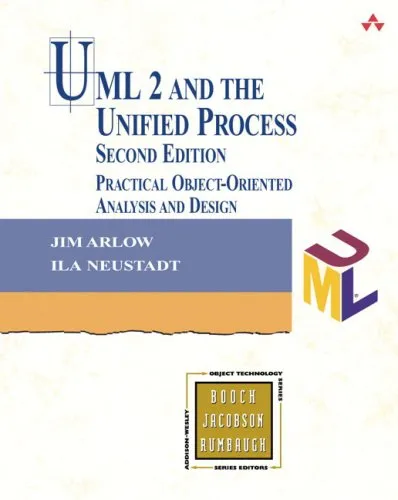
UML 2 and the Unified Process: Practical Object-Oriented Analysis and Design (2nd Edition)
Jim Arlow,Ila Neustadt
2005
View book
Book guide and evaluation
Larman
0 reviews
Published
pages
views
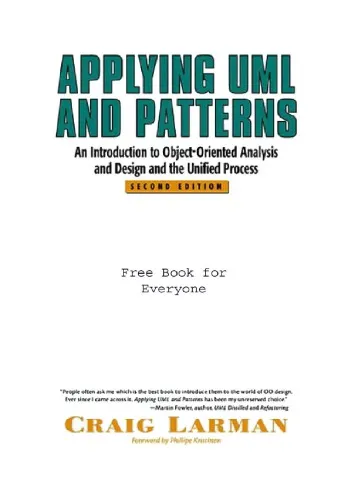
Welcome to the comprehensive introduction to "Applying UML and Patterns: An Introduction to Object-Oriented Analysis and Design and the Unified Process". This book, penned by the esteemed author Craig Larman, offers a robust foundation in the principles of UML and patterns.
Before you read
Welcome to the comprehensive introduction to "Applying UML and Patterns: An Introduction to Object-Oriented Analysis and Design and the Unified Process". This book, penned by the esteemed author Craig Larman, offers a robust foundation in the principles of UML and patterns. It is a guiding light for both beginners and seasoned professionals aiming to fortify their understanding of object-oriented analysis, design, and the unified process.
"Applying UML and Patterns" is structured to cater to a wide audience ranging from students to seasoned software developers. The book unfolds over various chapters, meticulously detailing the facets of object-oriented analysis and design (OOAD). Craig Larman adeptly weaves together the theoretical underpinnings with practical application, explaining the Unified Modeling Language (UML) and design patterns in a manner that is both accessible and comprehensive.
The narrative begins with a clear exposition of the basic principles of object-oriented technology. Starting with core concepts such as encapsulation, polymorphism, and inheritance, Larman builds a solid groundwork upon which further understanding of UML and patterns can flourish. As the chapters progress, readers are introduced to more detailed discussions surrounding design principles and methodologies encapsulated within the Unified Process.
Larman’s emphasis on iterative development and evolutionary design ensures that readers comprehend the dynamics of real-world software development processes. The book’s practical approach is exemplified through numerous examples and case studies that illustrate the benefit of adopting UML and OOAD in various scenarios. Readers are guided through the creation of software models that are agile, efficient, and capable of meeting evolving user requirements.
"Good design is about finding the sweet spot between too little abstraction and too much."
"It's not just the tools and technologies, but the understanding of what they do for you and where they fit into the overall plan."
"Applying UML and Patterns" is a seminal work that has left a significant mark in the field of software engineering. Its influence can be seen in the adoption of UML and design patterns as fundamental tools in software design education and practice. The book’s persisting relevance is attributed to Larman’s foresight in emphasizing adaptable, understandable, and efficient design practices.
The book matters because it bridges the gap between theoretical concepts and real-world application, ensuring that readers not only understand the "what" and "how" of software design but also the "why". This holistic approach prepares developers to tackle complex design challenges with an informed mindset, driving innovation and technical excellence in their work.
In the rapidly evolving landscape of software technology, "Applying UML and Patterns" remains a cornerstone text that has helped shape the education and careers of countless software professionals. Its teachings continue to inspire a new generation of developers who are keen on creating effective and elegant software solutions.
Your question is answered in the context of this title and author. Each answer uses 2 points.
0 reviews, 4.5 average out of 5
Sign in to publish a review.
Ask a focused question and learn from the community.
Related references that continue this learning path.
Jim Arlow,Ila Neustadt
Jim Arlow,Ila Neustadt
Arlow, Jim;Neustadt, Ila