

SOFTWARE ARCHITECTURE WITH C# 10 AND .NET 6 : develop software solutions using... microservices, devops, ef core, and design pattern.
GABRIEL ABBRUZZESE FRANCESCO BAPTISTA
2022
View book
Book guide and evaluation
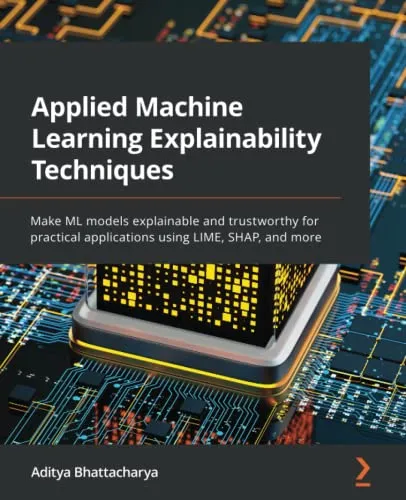
Aditya Bhattacharya
0 reviews
Published
pages
views
Introduction to "Applied Machine Learning Explainability Techniques" In the rapidly evolving landscape of Artificial Intelligence, machine learning models are increasingly becoming essential tools for decision-making across industries. However, as these models grow in comp
Before you read
In the rapidly evolving landscape of Artificial Intelligence, machine learning models are increasingly becoming essential tools for decision-making across industries. However, as these models grow in complexity, so does the challenge of making their inner workings understandable and their decisions trustworthy. "Applied Machine Learning Explainability Techniques: Make ML models explainable and trustworthy for practical applications using LIME, SHAP, and more" addresses this critical challenge head-on, making it an indispensable guide for data scientists, machine learning practitioners, and business leaders.
The book begins with a foundational understanding of the importance of model explainability. It discusses the ethical and practical imperatives for transparency in AI, particularly in high-stakes sectors like healthcare, finance, and legal systems. Through comprehensive coverage, the text introduces a variety of explainability techniques, such as LIME (Local Interpretable Model-Agnostic Explanations) and SHAP (Shapley Additive Explanations). It offers rich examples and hands-on case studies that guide readers through the implementation of these techniques in real-world scenarios. Each chapter meticulously explores different algorithms, the math behind them, and the ways in which they can be leveraged to uncover the decision-making processes of complex models.
Moreover, the book delves into the limitations and biases inherent in machine learning models, advocating for fairness and accountability in AI. Readers will learn not only how to interpret models but also how to validate and refine them to align better with ethical standards. By bridging theory with practice, the book equips its audience with the skills necessary to both critique and create models that meet the practical demands of transparency.
“In the race between model performance and interpretability, the winner must always be trust.”
“The opacity of a model is its wall; explainability is the window we build for transparency.”
“True intelligence in AI isn't just about prediction accuracy but in its ability to be understood and trusted.”
This book stands out as a vital resource in the AI community, owing to its comprehensive coverage of explainability techniques that are becoming increasingly important. As AI permeates more aspects of daily life, ensuring that these systems are transparent and accountable is not just good practice; it is imperative. The book guides practitioners not only in implementing technical solutions but also in adopting a mindset that values clarity, ethics, and responsibility in machine learning innovations.
In summary, "Applied Machine Learning Explainability Techniques" is much more than a technical guide; it is a manifesto for an accessible, ethically-grounded approach to cutting-edge AI technologies. By providing readers with the necessary tools to understand and explain machine learning models, it empowers them to foster trust and transparency in AI applications, laying the groundwork for a future where intelligent systems are both powerful and principled.
Your question is answered in the context of this title and author. Each answer uses 2 points.
0 reviews, 4.5 average out of 5
Sign in to publish a review.
Ask a focused question and learn from the community.
Related references that continue this learning path.
GABRIEL ABBRUZZESE FRANCESCO BAPTISTA

Gabriel Baptista,Francesco Abbruzzese