An introduction to the theory of functional equations and inequalities
Marek Kuczma,Attila Gilányi
2008
View book
Book guide and evaluation
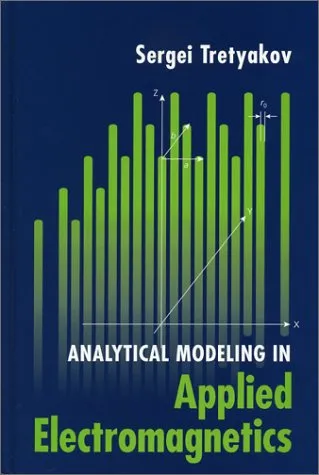
Sergei Tretyakov
0 reviews
Published
pages
views
Introduction to Analytical Modeling in Applied Electromagnetics "Analytical Modeling in Applied Electromagnetics" is a comprehensive guide crafted for professionals, researchers, and students who aspire to delve deeper into the theoretical and pract
Before you read
"Analytical Modeling in Applied Electromagnetics" is a comprehensive guide crafted for professionals, researchers, and students who aspire to delve deeper into the theoretical and practical aspects of electromagnetic phenomena. Written by Sergei Tretyakov, this book provides a structured approach to understanding how mathematics and physics combine to solve real-world electromagnetic problems.
The book is designed to bridge the gap between theory and application, making it an essential reference for those who wish to enhance their analytical skills in applied electromagnetics. With an emphasis on clarity and practicality, the book not only introduces fundamental concepts but also explores advanced topics, enabling readers to develop robust analytical solutions. Let us explore the essential components of this text in detail.
The essence of this book lies in its systematic approach to unraveling the complexities of applied electromagnetics. It starts with foundational concepts like Maxwell's equations, boundary conditions, and wave propagation. From there, it delves into sophisticated subjects such as antenna analysis, wave scattering, and metamaterials. The author emphasizes the use of analytical models as effective tools to tackle case-specific problems that often arise in engineering and scientific applications.
With carefully selected examples, Sergei Tretyakov provides insights into solving problems ranging from radiofrequency design to computational electromagnetics. The structured layout of the book ensures readers can seamlessly transition from basic principles to advanced models. Each chapter is enriched with theoretical discussions, supported by equations, and complemented with practical interpretations that resonate with real-world scenarios.
Whether you are a student seeking to learn the basics or a seasoned engineer exploring complex solutions, this book equips you with the essential tools and methods to succeed in the field of applied electromagnetics.
These key takeaways highlight the versatility of this book in addressing various challenges in applied electromagnetics. It serves as both a textbook for learners and a reference for experienced professionals.
"Analytical models are not just computational tools—they are the language through which we articulate and understand the universe of electromagnetics."
"In applied electromagnetics, the power of a theory lies not just in its elegance but in its ability to solve meaningful problems."
These quotes reflect the author's deep respect for both the theoretical beauty and practical utility of electromagnetics, a sentiment carried throughout every chapter.
The field of applied electromagnetics is central to modern technological advancements, from wireless communication systems to advanced radar technologies. "Analytical Modeling in Applied Electromagnetics" stands as a cornerstone for anyone aiming to contribute to these domains.
By blending mathematical rigor with practical insight, Sergei Tretyakov empowers readers to approach electromagnetic challenges with confidence. The analytical techniques detailed in the book provide an essential toolkit for addressing contemporary problems in science and engineering. Additionally, the book's clear structure ensures its accessibility to readers of varying expertise levels.
For academics, engineers, and anyone intrigued by the intricacies of fields and waves, this book is more than a reference—it is an invitation to think, model, and innovate. Its impact on the community of applied electromagnetics will be long-lasting, fostering new generations of thinkers and practitioners.
Your question is answered in the context of this title and author. Each answer uses 2 points.
0 reviews, 4.5 average out of 5
Sign in to publish a review.
Ask a focused question and learn from the community.
Related references that continue this learning path.
Marek Kuczma,Attila Gilányi

Palaniappan Kannappan (auth.)