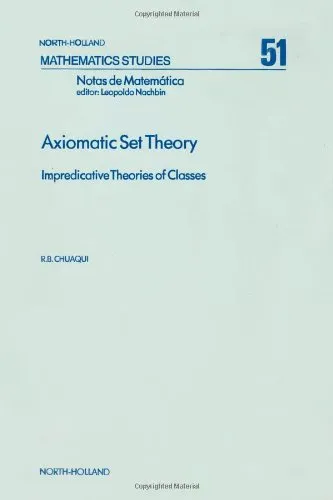
Axiomatic Set Theory: Theory Impredicative Theories of Classes
Leopoldo Nachbin (Eds.)
1981
View book
Book guide and evaluation
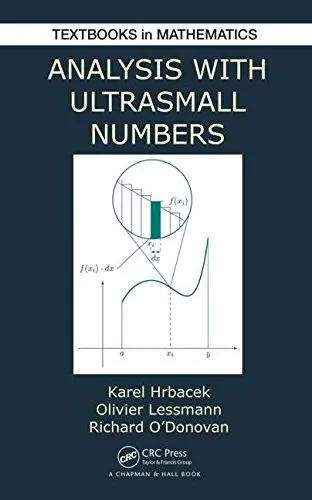
Karel Hrbacek;Olivier Lessmann;Richard O'Donovan
0 reviews
Published
pages
views
Analysis with Ultrasmall Numbers: A Guided Introduction Analysis with Ultrasmall Numbers is a groundbreaking book that revisits the foundations of calculus and mathematical analysis through the lens of nonstandard analysis. Written by Karel Hrbacek, Olivier Lessman
Before you read
Analysis with Ultrasmall Numbers is a groundbreaking book that revisits the foundations of calculus and mathematical analysis through the lens of nonstandard analysis. Written by Karel Hrbacek, Olivier Lessmann, and Richard O'Donovan, the work delves into an innovative approach toward understanding infinitesimals, functions, and limits, offering a fresh perspective that makes these concepts more intuitive and accessible. By adopting ultrasmall (infinitesimal) and ultralarge numbers, the authors simplify complex ideas without sacrificing mathematical rigor, bridging the gap between classical techniques and contemporary applications. This book is ideal for advanced undergraduates, graduate students, and professionals seeking a profound yet approachable discussion of modern mathematical concepts.
The book takes readers on a structured journey through nonstandard analysis, introducing concepts incrementally to ensure a deep understanding. It begins with an introduction to ultrasmall and ultralarge numbers, setting the stage for the rest of the text. These numbers, which satisfy properties very different from those found in standard real numbers, are essential in simplifying many complex ideas in mathematical analysis.
Topics such as continuity, differentiation, and integration are revisited using these ultrasmall numbers, replacing traditional limit-based definitions with constructs that are conceptually more straightforward. As the book progresses, readers are introduced to sequences and series, vector spaces, and functions on multiple variables, all explored from the ultrasmall perspective. By adopting this methodology, the authors provide a natural framework for understanding the nuances of calculus, making the subject more intuitive and less abstract.
The book also examines the historical and philosophical implications of this approach, shedding light on how infinitesimals have evolved within the history of mathematics. Grounded in careful axiomatic development, the text ensures that readers not only understand the rules and methods but also the underlying principles that make this framework possible. The comprehensive exercises and illustrative examples further solidify the knowledge presented.
Throughout the book, the authors provide intriguing insights into the nature of mathematical reasoning. Here are some notable excerpts:
"Infinitesimals are not just relics of a bygone mathematical era; they are vibrant tools that breathe new life into core concepts of analysis."
"By bridging the gap between formal rigor and intuitive simplicity, ultrasmall numbers illuminate the hidden elegance of calculus."
"The language of ultranumbers is not merely an alternative; it is a complement that enriches and deepens our understanding of mathematics."
Analysis with Ultrasmall Numbers holds significant importance for students and professionals alike. By providing an alternative route to understanding calculus and analysis, it addresses some of the perennial challenges associated with these topics. The presentation of nonstandard analysis as a tool for engaging with ultrasmall and ultralarge numbers goes beyond esotericism; it represents a pragmatic way to refine intuition and bolster comprehension.
The book’s approach is not merely theoretical. Its practical benefits are immense, especially for mathematicians, educators, and scientists grappling with complex systems. The innovative focus on ultrasmall numbers opens doors to new ways of teaching foundational mathematics, making it more accessible to learners with diverse backgrounds. Moreover, the philosophical reflections interspersed through the text provide a richer understanding of the subject’s historical development and intellectual underpinnings.
In an era where mathematics often feels disconnected from its historical roots, this book bridges the divide, inviting readers to explore not just "how" but also "why" mathematics works. This intellectual curiosity, supported by clear arguments and practical exercises, makes the book an essential read for anyone interested in enhancing their grasp of modern and classical analysis.
Your question is answered in the context of this title and author. Each answer uses 2 points.
0 reviews, 4.5 average out of 5
Sign in to publish a review.
Ask a focused question and learn from the community.
Related references that continue this learning path.
Leopoldo Nachbin (Eds.)
Charles M. Quinn