Book guide and evaluation
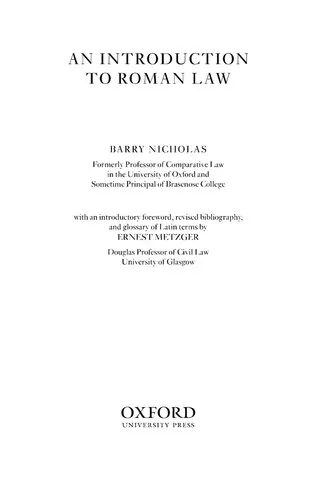
An Introduction to Roman Law
Barry Nicholas,Ernest Metzger
English
Intermediate
novel
4.5 / 5
0 reviews
1976
Published
317
pages
1034
views
Introduction to Roman Law Roman law serves as one of the fundamental pillars upon which modern legal systems are built. In "An Introduction to Roman Law," Barry Nicholas provides an insightful and comprehensive guide to understanding the intricacies and historical importance o
Before you read
What will you get from this book?
Introduction to Roman Law
Roman law serves as one of the fundamental pillars upon which modern legal systems are built. In "An Introduction to Roman Law," Barry Nicholas provides an insightful and comprehensive guide to understanding the intricacies and historical importance of Roman legal principles.
Detailed Summary of the Book
Barry Nicholas's "An Introduction to Roman Law" offers a scholarly yet accessible overview of Roman legal systems. It dissects the evolution and enduring influence of Roman law, beginning with the Twelve Tables and continuing through the era of Justinian. The book meticulously explores various facets of Roman law, including its sources, the function of magistrates, and the development of legal concepts. Nicholas delves into private law, particularly contracts, property, and personal status, providing readers with a clear understanding of how Roman legal ideas have been adapted and integrated into contemporary legal frameworks.
Throughout the text, the author emphasizes the Roman emphasis on justice and order, illustrating how these ideals were codified in their legal system. The book is designed for both students new to Roman law and experienced scholars, offering detailed explanations and analyses that inspire further exploration and study.
Key Takeaways
- Foundational Structure: Roman law serves as the bedrock for many Western legal systems, highlighting principles such as equity, fairness, and reason.
- Diverse Legal Sources: Understanding the complexity of Roman law requires familiarity with its varied sources, including statutes, customary practices, and legal commentaries.
- Influence on Modern Law: Concepts such as contracts, torts, and property rights in modern law have roots in Roman juridical thought.
- Evolution of Law: The development of Roman law is marked by significant reforms, notably during the Justinian era, which sought to systematize and consolidate legal practices.
- Philosophical Underpinnings: The philosophical and ethical foundations inherent in Roman law continue to influence contemporary legal debates and discussions.
Famous Quotes from the Book
"The Roman law is not merely a historical artifact but a vibrant and dynamic field of study influencing modern civilization’s understanding of law and justice."
"In the foundations of Roman law, we find the roots not only of legal systems but also of the innate human desire for fairness and justice."
Why This Book Matters
"An Introduction to Roman Law" is essential for anyone interested in the history and evolution of legal thought. Barry Nicholas’s narrative is not just historical but also analytical, making it relevant to modern legal scholars and practitioners. By highlighting the transition of Roman law from an ancient system to one that influences present-day legal frameworks, the book bridges the past with the future of legal theory and practice.
The book’s emphasis on the practical implications of Roman law in today's world makes it a valuable resource for comparative law studies, offering insights into how ancient principles can be interpreted and applied in modern contexts. This work not only enriches the reader’s understanding of Roman law but also enhances appreciation for the origins and development of legal systems globally.
Ask this book
Your question is answered in the context of this title and author. Each answer uses 2 points.
Sign in to ask the book assistant.
Reader reviews
0 reviews, 4.5 average out of 5
No reviews yet
If you have read this book, help the next reader with your experience.
Write a review
Sign in to publish a review.
Reader questions and answers
Ask a focused question and learn from the community.
Sign in to ask or answer a question.
No questions yet
Be the first to ask a clear, useful question.
What to read next
Related references that continue this learning path.