

SOFTWARE ARCHITECTURE WITH C# 10 AND .NET 6 : develop software solutions using... microservices, devops, ef core, and design pattern.
GABRIEL ABBRUZZESE FRANCESCO BAPTISTA
2022
View book
Book guide and evaluation
Merrie Bergmann
0 reviews
Published
pages
views
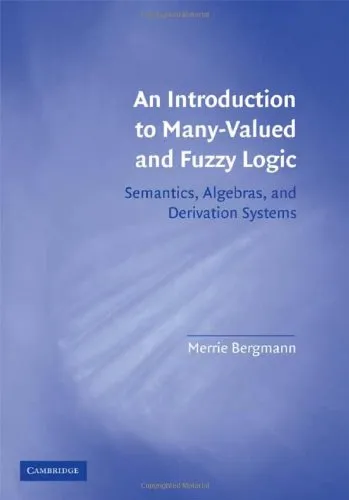
Introduction to the Book An Introduction to Many-Valued and Fuzzy Logic: Semantics, Algebras, and Derivation Systems Authored by Merrie Bergmann, this comprehensive book serves as a pivotal resource for anyone interested in the realms of logic that transcend classical binary
Before you read
An Introduction to Many-Valued and Fuzzy Logic: Semantics, Algebras, and Derivation Systems
Authored by Merrie Bergmann, this comprehensive book serves as a pivotal resource for anyone interested in the realms of logic that transcend classical binary paradigms. As traditional logic deals with strict true or false values, many-valued and fuzzy logic offer a more nuanced approach suitable for understanding and modeling the complexities of real-world situations.
The book delves into the theoretical underpinnings and practical applications of many-valued and fuzzy logic. It explores the semantics, algebras, and derivation systems that form the backbone of these logical systems. Bergmann begins with an introduction to the motivations behind many-valued logic, highlighting the limitations of classical two-valued logic and the need for more expressive systems.
Subsequent chapters methodically cover the spectrum of many-valued logic systems, from three-valued logics to t-norm based fuzzy logics. Readers will find extensive discussions on the algebraic structures that underpin these logics, such as MV-algebras, and the evaluation techniques used to interpret fuzzy statements. The progression of topics is designed to provide a strong foundation before delving into advanced concepts like Łukasiewicz logic and Gödel logic.
"In many-valued logic, the rigidity of classical logic gives way to a spectrum of possibilities, each suitable for a different logical or computational need."
"Fuzzy logic represents a shift from the categorical to the gradual, where logic meets the intricate dance of real life."
In today's complex and interconnected world, binary logic models are often insufficient to encapsulate the nuances and gradations of reality. This book is crucial because it empowers both students and researchers with the tools to navigate these complexities through many-valued and fuzzy logics. By offering a rigorous yet accessible exploration of these topics, Bergmann's work provides the foundational knowledge required to apply these logics in diverse fields such as artificial intelligence, data science, and systems modeling.
The book's structured approach ensures that readers not only grasp the theoretical concepts but also appreciate their practical applications. This is particularly important as these logics play an increasingly significant role in technological advancements that rely on sophisticated decision-making processes.
Overall, "An Introduction to Many-Valued and Fuzzy Logic: Semantics, Algebras, and Derivation Systems" is an essential read for those looking to extend their understanding beyond classical logic and explore the continuum of possibilities that many-valued and fuzzy logics offer.
Your question is answered in the context of this title and author. Each answer uses 2 points.
0 reviews, 4.5 average out of 5
Sign in to publish a review.
Ask a focused question and learn from the community.
Related references that continue this learning path.
GABRIEL ABBRUZZESE FRANCESCO BAPTISTA

Robert C. Martin