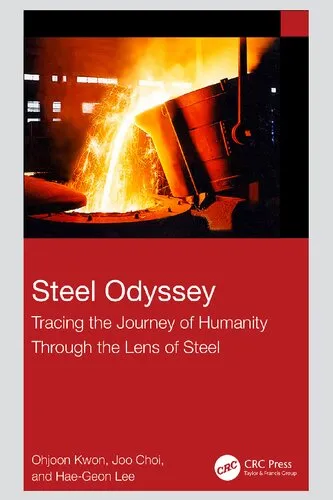
Steel Odyssey: Tracing the Journey of Humanity Through the Lens of Steel
Ohjoon Kwon,Joo Choi,Hae-Geon Lee
2024
View book

Book guide and evaluation
Hua, Julietta (author);Ahuja, Neel (author)
0 reviews
Published
pages
views
American Quarterlypp.619—637 critical race theory, transnational feminist analysis An in-depth exploration of American Quarterlypp.619—637, examining intersectional politics and transnational scholarly perspectives. Analytical Summary The work titled American Quarterlypp.61
Before you read
The work titled American Quarterlypp.619—637 represents a dense and thought-provoking contribution to contemporary scholarly debates, authored by Julietta Hua and Neel Ahuja. It occupies a significant place in intellectual discourse that intersects cultural studies, critical race theory, and global political analysis. Although the exact publication year is “Information unavailable” due to the absence of reliable public sources, the content clearly engages a readership deeply invested in interdisciplinary methodologies.
This selection, extracted from the broader journal context of American Quarterly, is noteworthy for its focus on the entanglements of race, gender, environment, and geopolitical paradigms. It builds on the premise that U.S. imperial and domestic policies cannot be studied in isolation, but rather through a transnational lens that accounts for the flow of ideas, capital, bodies, and cultural narratives across borders.
The authors weave together theoretically rich frameworks with grounded empirical cases, situating their analysis within a lineage of intersectional thought while pressing new questions about power and justice. Through their critical engagement, readers are invited to consider how disciplinary boundaries might be transcended to better understand contemporary political and cultural phenomena.
From American Quarterlypp.619—637, several key intellectual and practical insights emerge for scholars, activists, and policymakers.
First, the text underscores the necessity of analyzing U.S. policy and culture within a global frame, challenging parochial or exceptionalist narratives. Second, it demonstrates how critical race theory and transnational feminist analysis operate synergistically to illuminate hidden power structures.
Third, it offers compelling directions for future research, particularly in the integration of environmental justice concerns with socio-political critique. Lastly, it models scholarly writing that is accessible yet rigorous, making it valuable both in graduate seminars and strategic policy discussions.
The complexity of empire is illuminated when we refuse to think of the United States as bounded by its geography. Unknown
An adequate critique must move across scales—personal, institutional, and global—to grasp the lived realities of policy. Unknown
Intersectionality is not just a theory; it is a methodological imperative in a transnational world. Unknown
The significance of American Quarterlypp.619—637 lies in its ability to bridge domains of scholarly inquiry, making it a foundational text for those studying the intersection of domestic and global politics.
By employing critical race theory alongside transnational feminist analysis, Hua and Ahuja advance a form of critique that is both contextually sensitive and theoretically sophisticated. Their approach speaks to contemporary crises—migration, climate change, neoliberal restructuring—that transcend national borders.
For academics, this work provides a model for integrating multiple critical traditions. For professionals in policy and advocacy, it offers conceptual tools for grappling with complex, intertwined social challenges.
In revisiting American Quarterlypp.619—637, we discover a work that challenges us to think beyond conventional national narratives and to engage with a more interconnected, critically aware worldview.
The text’s enduring relevance lies in its invitation to readers—not merely to consume knowledge, but to participate in the ongoing project of critical inquiry. Hua and Ahuja’s collaboration serves as an exemplary map for traversing disciplinary boundaries and confronting the pressing issues of our time.
If you are a scholar, professional, or engaged citizen seeking to deepen your understanding of how global and local dynamics co-produce the world we inhabit, make time to read, share, and discuss American Quarterlypp.619—637. In doing so, you align yourself with a tradition of thoughtful, transformative scholarship.
Your question is answered in the context of this title and author. Each answer uses 2 points.
0 reviews, 4.9 average out of 5
Sign in to publish a review.
Ask a focused question and learn from the community.
Related references that continue this learning path.
Ohjoon Kwon,Joo Choi,Hae-Geon Lee
Cisneros, Sandra;House on Mango Street;Herrera-Sobek, María

Muhammad Ibn Sa'd,Aisha Bewley