
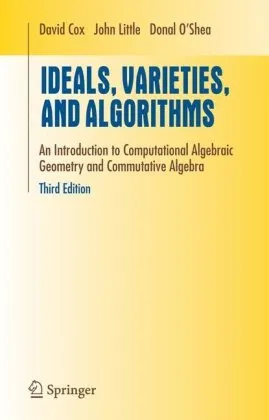
Ideals, varieties, and algorithms: an introduction to computational algebraic geometry and commutative algebra
David A. Cox,John Little,Donal O’Shea
2007
View book
Book guide and evaluation
Martin Charles Golumbic (Eds.)
0 reviews
Published
pages
views
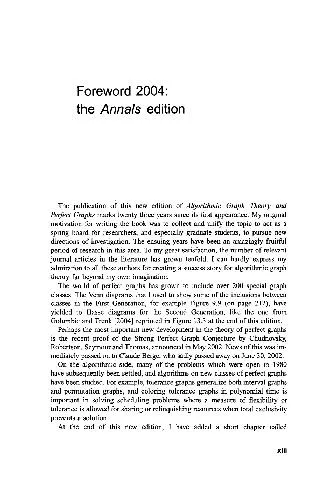
Welcome to the exploration of the intersection of algorithmic graph theory and the mesmerizing world of perfect graphs. In this fascinating domain, deep theoretical insights meet practical computational techniques, offering rich and significant applications across numerous fi
Before you read
Welcome to the exploration of the intersection of algorithmic graph theory and the mesmerizing world of perfect graphs. In this fascinating domain, deep theoretical insights meet practical computational techniques, offering rich and significant applications across numerous fields. This book serves as both an introduction and a comprehensive guide, providing readers with thorough coverage of both foundational concepts and cutting-edge research. Our goal is to equip professionals, researchers, and students alike with the tools and understanding necessary to excel in this exciting area of study.
The book 'Algorithmic Graph Theory and Perfect Graphs' unfolds the intricate layers of graph theory with an emphasis on perfect graphs. The early chapters meticulously introduce graph theory concepts including graphs, digraphs, trees, and network flows, setting the stage for more advanced topics. The core of the book revolves around the perfection of graphs—a concept crucial for understanding a variety of applications from scheduling to network optimization.
The narrative is structured to gradually build a reader’s mastery, starting with the seminal theorems of chordal and interval graphs, and then advancing to the complexities of recognition algorithms and decomposition techniques of perfect graphs. The latter chapters are dedicated to exploring particular types of perfect graphs like comparability graphs, co-graphs, and the association between perfect graphs and problems in linear programming.
This edition is enriched with algorithms that are presented in a refined manner, emphasizing not just the 'how' but also the 'why' behind each method. The integration of exercises and problems encourages a deep engagement with topics, fostering a practical understanding of theoretical concepts.
"Graphs are for everyone; their beauty is visible in every network, every connection, and the endless problems they can solve."
"To understand perfect graphs is to comprehend the fine balance between complexity and simplicity in networks."
This book stands as a vital resource in the library of anyone interested in computational and mathematical sciences. It bridges the gap between theoretical research and practical application, making it invaluable to both academic and industry professionals. More than just a textbook, it is a key to unlocking the potential of graph theory in solving real-world problems efficiently and effectively.
In a world increasingly driven by data and connections, understanding graph theory is no longer just an academic exercise but a critical skill in tackling challenges in computer science, operations research, and beyond. By offering clarity on complex concepts, the book empowers readers to apply graph-theoretic techniques to diverse areas such as telecommunications, biology, and artificial intelligence.
As technology continues to evolve, the principles laid down in 'Algorithmic Graph Theory and Perfect Graphs' will continue to provide foundational knowledge and inspire innovations for years to come, solidifying its place as an indispensable text in the field.
Your question is answered in the context of this title and author. Each answer uses 2 points.
0 reviews, 4.5 average out of 5
Sign in to publish a review.
Ask a focused question and learn from the community.
Related references that continue this learning path.
David A. Cox,John Little,Donal O’Shea
Michael T. Goodrich,Roberto Tamassia,Michael H. Goldwasser
Kent Lee,Steve Hubbard