
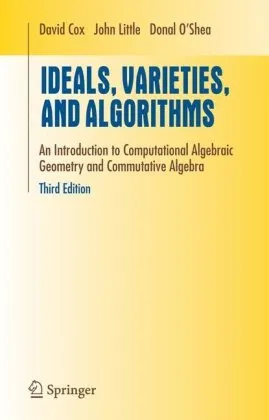
Ideals, varieties, and algorithms: an introduction to computational algebraic geometry and commutative algebra
David A. Cox,John Little,Donal O’Shea
2007
View book
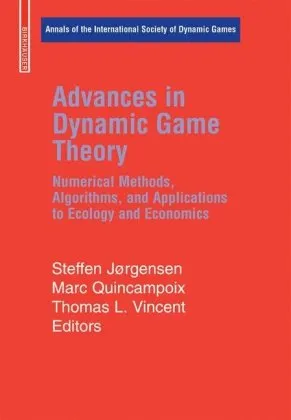
Book guide and evaluation
Steffen Jorgensen,Marc Quincampoix,Thomas L. Vincent
0 reviews
Published
pages
views
Introduction to "Advances in Dynamic Game Theory: Numerical Methods, Algorithms, and Applications to Ecology and Economics" Dynamic game theory is an intriguing field that merges concepts from mathematics, economics, and biology to address conflict and cooperation situatio
Before you read
Dynamic game theory is an intriguing field that merges concepts from mathematics, economics, and biology to address conflict and cooperation situations involving multiple decision-makers. This book takes the reader on a comprehensive journey through the theoretical developments and cutting-edge applications of dynamic game theory, with a spotlight on numerical methods, algorithms, and real-world applications in ecology and economics.
In this compendium, each chapter is meticulously crafted by experts who focus on various aspects of dynamic game theory. The book is structured into specific segments that delve into theoretical advancements, computational techniques, and practical applications. Through rigorous exploration, it tackles complex scenarios involving multiple agents with differing objectives, resource allocations, and strategic interactions over time.
The initial sections lay down the theoretical framework, elaborating on recent advances in game theory models that incorporate time and uncertainty. These sections provide the mathematical underpinnings and equilibrium concepts crucial for understanding dynamic interactions.
Subsequent chapters explore the development of algorithms tailored to solve dynamic games, emphasizing computational efficiency and accuracy. Here, numerical methods are scrutinized, focusing on algorithms designed to compute equilibria in dynamic strategic environments. The reader will gain insights into the inherent computational challenges and how recent algorithmic innovations address these issues.
The book further explores applications in ecology and economics, illustrating how dynamic game theory can model and solve problems related to environmental management, resource allocation, and economic competition. Discussions go beyond abstract theory and into tangible applications, offering a bridge between mathematical rigor and practical utility.
“In the realm of dynamic conflicts, strategies are not merely decisions; they are the art of foresight, deeply entwined with the mathematics of change and adaptation.”
“The strength of dynamic game theory lies in its dual nature: a theoretical framework matched in complexity only by the intricacy of real-world applications.”
This book is an essential read for scholars and practitioners in mathematics, economics, and ecology interested in the dynamics of strategic interaction. Its unique blend of theory, computation, and application provides a holistic view of the field, making it a valuable resource for those looking to advance their understanding or apply dynamic game theory to real-world problems.
The relevance of this book extends beyond academia and into practical scenarios where strategic decision-making is critical. By offering solutions to contemporary problems through the lens of dynamic game theory, it supports policymakers, economists, and ecologists in crafting strategies that are not only effective but sustainable in an ever-changing world.
In sum, "Advances in Dynamic Game Theory" equips its readers with the tools to navigate and influence the interplay of competing agendas in dynamic settings, ultimately contributing to advancements in numerous fields reliant on strategic foresight and cooperative dynamics.
Your question is answered in the context of this title and author. Each answer uses 2 points.
0 reviews, 4.6 average out of 5
Sign in to publish a review.
Ask a focused question and learn from the community.
Related references that continue this learning path.
David A. Cox,John Little,Donal O’Shea
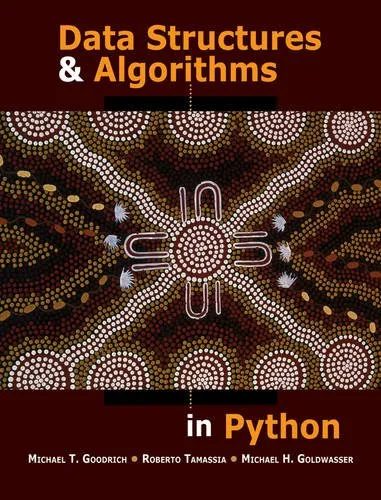
Michael T. Goodrich,Roberto Tamassia,Michael H. Goldwasser
Kent Lee,Steve Hubbard