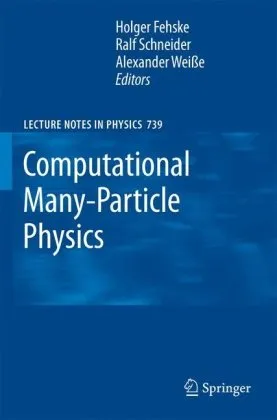
Computational Many-Particle Physics
Ralf Schneider,Amit Raj Sharma,Abha Rai (auth.),H. Fehske,R. Schneider,A. Weiße (eds.)
2008
View book

Book guide and evaluation
Herbert Enderton,Herbert B. Enderton
0 reviews
Published
pages
views
Introduction to "A Mathematical Introduction to Logic, Second Edition" Herbert Enderton's A Mathematical Introduction to Logic, Second Edition is a seminal work that explores the foundational aspects of mathematical logic. It is a comprehensive guide to understanding forma
Before you read
Herbert Enderton's A Mathematical Introduction to Logic, Second Edition is a seminal work that explores the foundational aspects of mathematical logic. It is a comprehensive guide to understanding formal systems, logical structures, and foundational principles that underpin various branches of mathematics and computer science. Designed for both students and educators, this book has left a lasting impact on the study of logic by balancing rigor, accessibility, and depth.
The second edition of A Mathematical Introduction to Logic consists of an in-depth exploration of both propositional logic and first-order logic. The book is divided into two main parts:
Enderton's lucid explanations make abstract concepts more comprehensible, while the numerous exercises at the end of each chapter reinforce the material. This edition also introduces readers to more advanced topics, such as second-order logic and the expressive limitations of formal systems. Throughout the book, Enderton focuses on presenting logic as a vital and vibrant field of study that connects mathematics, philosophy, and computer science.
The book is packed with insights and knowledge, but the following are the key takeaways:
Here are some thought-provoking quotes from A Mathematical Introduction to Logic that capture the essence of the work:
“The purpose of studying logic is not simply to observe the form of mathematical theories, but to explore the limitations and potential of formal reasoning.”
“To understand what a proof really is, we must first explore the syntax that governs our logical systems and the semantics that give these systems meaning.”
“Mathematical logic lies at the intersection of mathematics and philosophy, focusing on what can and cannot be formally expressed.”
Enderton’s book stands out in the field of mathematical logic for several reasons:
In today's world, where formal reasoning plays a crucial role in areas like artificial intelligence, database theory, and cybersecurity, the principles outlined in this book remain profoundly relevant. Whether you are a student, researcher, or educator, Enderton’s work equips you with tools to navigate and understand the logical frameworks at the heart of the mathematical sciences.
Your question is answered in the context of this title and author. Each answer uses 2 points.
0 reviews, 4.6 average out of 5
Sign in to publish a review.
Ask a focused question and learn from the community.
Related references that continue this learning path.
Ralf Schneider,Amit Raj Sharma,Abha Rai (auth.),H. Fehske,R. Schneider,A. Weiße (eds.)
László Lovász,József Pelikán,Katalin Vesztergombi
National Research Council; Committee on DoctoralandPostdoctoral Study in the United States