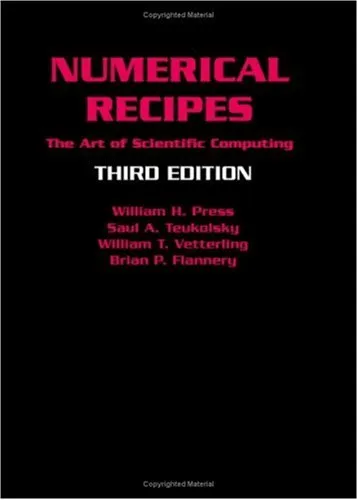
Numerical recipes: the art of scientific computing
William H. Press,Saul A. Teukolsky,William T. Vetterling,Brian P. Flannery
2007
View book
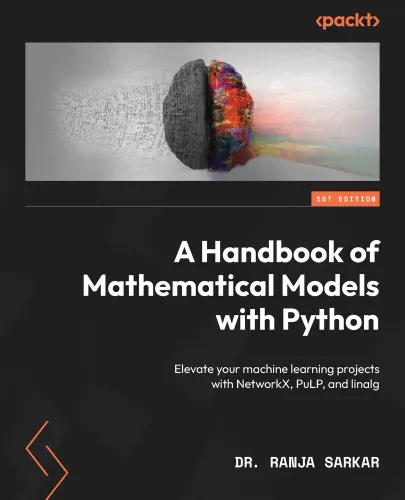
Book guide and evaluation
Dr. Ranja Sarker
0 reviews
Published
pages
views
Introduction to "A Handbook of Mathematical Models with Python" Mathematics and programming are two indispensable pillars of innovation that shape modern science, technology, and engineering. "A Handbook of Mathematical Models with Python" bridges the gap between theor
Before you read
Mathematics and programming are two indispensable pillars of innovation that shape modern science, technology, and engineering. "A Handbook of Mathematical Models with Python" bridges the gap between theoretical mathematics and practical implementation through Python, one of the most popular programming languages today. Whether you are a scientist, engineer, student, or programming enthusiast, this book serves as a roadmap to solve real-world problems with mathematical models in Python. In this comprehensive guide, you'll find everything you need to understand, design, and implement mathematical models effectively.
The book is divided into carefully structured chapters that cater to all levels of expertise—from beginners seeking foundational knowledge to advanced users looking for nuanced insights. Each chapter introduces mathematical concepts, their relevance in various fields, and step-by-step programming techniques to implement the models using Python. The topics covered include but are not limited to linear algebra, calculus, optimization, probability, differential equations, and machine learning algorithms. Importantly, the book emphasizes the intuitive understanding of mathematical concepts before diving deep into coding, making complex ideas approachable yet rigorous.
Additionally, this handbook leverages Python's powerful libraries such as NumPy, SciPy, SymPy, and Matplotlib to equip readers with the tools they need for efficient data analysis, scientific computing, and visualization. Practical examples, hands-on exercises, and real-world case studies ensure that the knowledge gained from this book is immediately applicable.
"Mathematics without an application is art; Python without mathematics is automation. Together, they create innovation."
"A model is not just a mathematical equation—it's a way of thinking, understanding, and solving problems."
"A Handbook of Mathematical Models with Python" stands apart because it doesn't just teach mathematics or Python independently; it merges them to address real-world challenges. In the age of data-driven decision-making, the ability to model complex systems, analyze outcomes, and simulate scenarios is invaluable across industries—from healthcare to finance, robotics, and beyond.
Furthermore, the book promotes a systematic approach to solving problems—starting from fundamental concepts and gradually progressing toward practical implementation. Whether you aspire to develop algorithms for self-driving cars or optimize a supply chain network, the tools you need are within these pages. By the end of this book, you'll not only have learned mathematical modeling but will also be empowered to innovate and lead in your field.
"A Handbook of Mathematical Models with Python" is your gateway to mastering the art and science of mathematical modeling through Python.
Your question is answered in the context of this title and author. Each answer uses 2 points.
0 reviews, 4.5 average out of 5
Sign in to publish a review.
Ask a focused question and learn from the community.
Related references that continue this learning path.
William H. Press,Saul A. Teukolsky,William T. Vetterling,Brian P. Flannery