
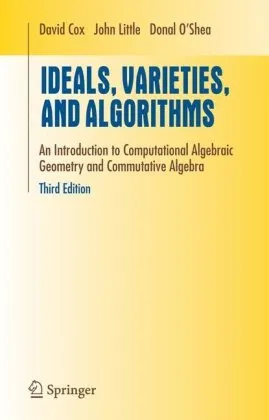
Ideals, varieties, and algorithms: an introduction to computational algebraic geometry and commutative algebra
David A. Cox,John Little,Donal O’Shea
2007
View book
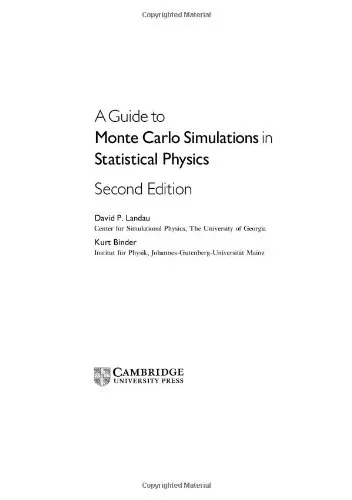
Book guide and evaluation
David P. Landau,Kurt Binder
0 reviews
Published
pages
views
Introduction to "A Guide to Monte Carlo Simulations in Statistical Physics" "A Guide to Monte Carlo Simulations in Statistical Physics" by David P. Landau and Kurt Binder is an essential resource for understanding the intricacies of Monte Carlo methods and their ap
Before you read
"A Guide to Monte Carlo Simulations in Statistical Physics" by David P. Landau and Kurt Binder is an essential resource for understanding the intricacies of Monte Carlo methods and their applications in statistical physics. This book has become a cornerstone in both academia and industry for researchers, students, and practitioners who wish to deepen their understanding of these computational techniques and apply them to problems in condensed matter physics, materials science, and beyond.
With a clear emphasis on both theoretical foundations and practical applications, the book seamlessly combines rigorous explanations of statistical mechanics with hands-on examples of Monte Carlo simulations. Whether you are a beginner or an experienced physicist looking to refine your skillset, this text provides valuable insights and guidance for every level.
The book begins by introducing the reader to the fundamentals of statistical mechanics, establishing a critical theoretical base for understanding Monte Carlo simulations. The authors go on to describe the core principles of the Monte Carlo method, focusing on its significance and diverse applications. The chapters are meticulously structured to build knowledge incrementally, covering both equilibrium and nonequilibrium phenomena through Monte Carlo techniques.
Key areas discussed in the book include Markov chains, importance sampling, the Metropolis algorithm, cluster algorithms, and the Wang-Landau method. These topics are carefully explained, along with their relevance to solving problems associated with phase transitions, critical phenomena, and lattice models. Moreover, practical programming and coding insights are provided, blending theory with application in a way that enriches the learning experience.
A unique attribute of the book is its emphasis on error estimation, finite-size effects, and data analysis—critical components often overlooked in other resources. By addressing these challenges, the authors equip readers with both the tools and the confidence to design and analyze simulations effectively. Updated throughout its various editions, the book also covers advanced topics such as parallelization, multiscale modeling, and applications to more complex systems.
"The Monte Carlo method might seem like a brute-force approach, but its elegance lies in its simplicity and ability to solve problems beyond the reach of traditional analytical approaches."
"Statistical mechanics transforms intractable many-body problems into manageable concepts when combined with Monte Carlo simulations."
"The art of Monte Carlo simulation is not just in running the computations but in the skillful analysis and interpretation of the results."
"A Guide to Monte Carlo Simulations in Statistical Physics" is more than just a textbook; it is a comprehensive guide that serves as a bridge between theoretical physics and computational methods. Monte Carlo simulations have become indispensable in diverse fields such as materials science, biology, machine learning, and economics. This book equips readers with the knowledge and skills to use these methods effectively.
In an era where computational physics plays a pivotal role in scientific discovery and technological advances, this book is a must-read. It provides not just tools but a way of thinking critically about modeling and simulation, empowering readers to explore complex phenomena. The authors' clear and methodical approach ensures that even those new to the subject can grasp challenging concepts and develop proficiency, making this book a timeless asset for anyone involved in computational sciences.
Your question is answered in the context of this title and author. Each answer uses 2 points.
0 reviews, 4.4 average out of 5
Sign in to publish a review.
Ask a focused question and learn from the community.
Related references that continue this learning path.
David A. Cox,John Little,Donal O’Shea
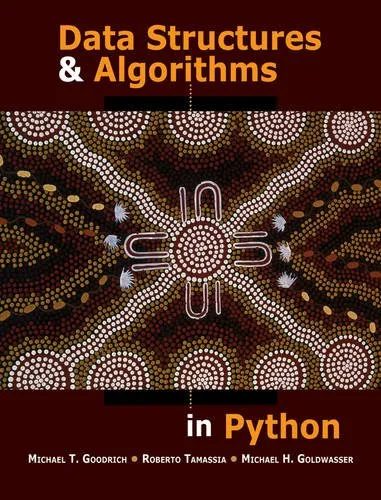
Michael T. Goodrich,Roberto Tamassia,Michael H. Goldwasser
Kent Lee,Steve Hubbard