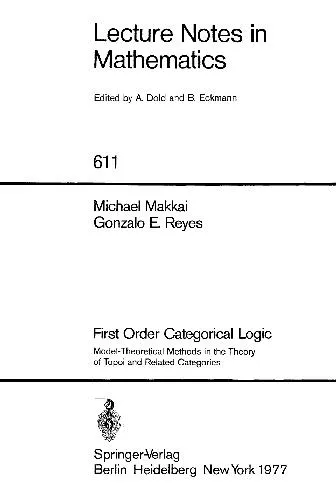
First Order Categorical Logic: Model-Theoretical Methods in the Theory of Topoi and Related Categories
Michael Makkai,Gonzalo E. Reyes
1977
View book
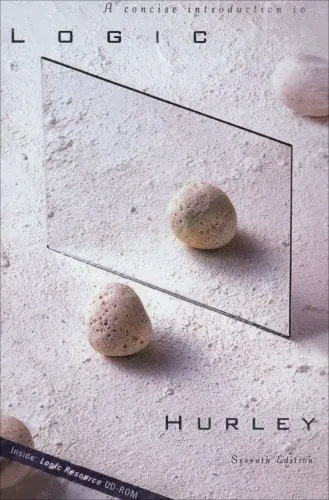
Book guide and evaluation
Patrick J. Hurley
0 reviews
Published
pages
views
Introduction to 'A Concise Introduction to Logic' Welcome to 'A Concise Introduction to Logic', a leading text on logic that offers a complete, nuanced understanding of the principles, methods, and fallacies that govern human reasoning. This introduction aims to
Before you read
Welcome to 'A Concise Introduction to Logic', a leading text on logic that offers a complete, nuanced understanding of the principles, methods, and fallacies that govern human reasoning. This introduction aims to equip you with the tools you need for critical thinking and clear decision-making, essential skills in today's complex world.
A Concise Introduction to Logic is known for its clear and comprehensive way of presenting the fundamental principles of logic. This book strikes a fine balance between theory and practice, starting with the basic elements of logic, such as propositions, arguments, deductive reasoning, and inductive reasoning. The text delves into various types of logic, including categorical, propositional, and symbolic, with detailed explanations of how these apply to real-world reasoning.
Structured to lead you from foundational concepts to advanced application techniques, the book carefully constructs a path to understanding complex logical reasoning. It includes insight into informal fallacies, which will allow readers to recognize and rectify errors in reasoning, both in their own thinking and in persuasive rhetoric. With a focus on contemporary applications, the book bridges the gap between abstract principles and everyday logic, making it an invaluable resource for both students and professionals aiming to improve their critical thinking abilities.
"Logic is the anatomy of thought."
"The aim of logic, as of all reasoning, is a simplification."
These quotes encapsulate the essence of logical study as depicted in this book, highlighting the role of logic in simplifying and understanding our thoughts and the world around us.
In a world filled with information overload and persuasive arguments, 'A Concise Introduction to Logic' serves as a beacon of clarity and precision. It empowers readers to sift through vast amounts of data to discern truth from assumption, thereby fostering informed decision-making. Furthermore, the book is a vital resource in academia, acting as the cornerstone for courses that introduce students to logic, critical thinking, and reasoning.
By demystifying complex logical doctrines and presenting them in an accessible manner, this book plays a crucial role in making logic approachable for all. It is an essential read for those looking to enhance their reasoning skills, whether for personal development or professional advancement. Through its rigorous yet comprehensible style, 'A Concise Introduction to Logic' remains a valuable tool in the intellectual toolkit of its readers.
Your question is answered in the context of this title and author. Each answer uses 2 points.
0 reviews, 4.5 average out of 5
Sign in to publish a review.
Ask a focused question and learn from the community.
Related references that continue this learning path.
Michael Makkai,Gonzalo E. Reyes
Petr Cintula,Carles Noguera
Charles S. Chihara