Loading
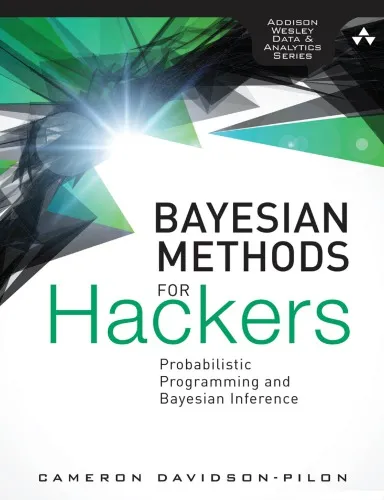
Cover of Bayesian Methods for Hackers: Probabilistic Programming and Bayesian Inference
English Advanced مهندسی نرم‌افزار

Bayesian Methods for Hackers: Probabilistic Programming and Bayesian Inference

Cameron Davidson-Pilon

Cameron Davidson-Pilon

4.4 / 5

0 نظر

2015

سال انتشار

252

صفحه

431

بازدید

Master Bayesian Inference through Practical Examples and Computation–Without Advanced Mathematical Analysis Bayesian methods of inference are deeply natural and extremely powerful. However, most discussions of Bayesian inference rely on intensely complex mathematical analyses a

درباره این کتاب

Master Bayesian Inference through Practical Examples and Computation–Without Advanced Mathematical Analysis Bayesian methods of inference are deeply natural and extremely powerful. However, most discussions of Bayesian inference rely on intensely complex mathematical analyses and artificial examples, making it inaccessible to anyone without a strong mathematical background. Now, though, Cameron Davidson-Pilon introduces Bayesian inference from a computational perspective, bridging theory to practice–freeing you to get results using computing power. Bayesian Methods for Hackers illuminates Bayesian inference through probabilistic programming with the powerful PyMC language and the closely related Python tools NumPy, SciPy, and Matplotlib. Using this approach, you can reach effective solutions in small increments, without extensive mathematical intervention. Davidson-Pilon begins by introducing the concepts underlying Bayesian inference, comparing it with other techniques and guiding you through building and training your first Bayesian model. Next, he introduces PyMC through a series of detailed examples and intuitive explanations that have been refined after extensive user feedback. You’ll learn how to use the Markov Chain Monte Carlo algorithm, choose appropriate sample sizes and priors, work with loss functions, and apply Bayesian inference in domains ranging from finance to marketing. Once you’ve mastered these techniques, you’ll constantly turn to this guide for the working PyMC code you need to jumpstart future projects. Coverage includes • Learning the Bayesian “state of mind” and its practical implications • Understanding how computers perform Bayesian inference • Using the PyMC Python library to program Bayesian analyses • Building and debugging models with PyMC • Testing your model’s “goodness of fit” • Opening the “black box” of the Markov Chain Monte Carlo algorithm to see how and why it works • Leveraging the power of the “Law of Large Numbers” • Mastering key concepts, such as clustering, convergence, autocorrelation, and thinning • Using loss functions to measure an estimate’s weaknesses based on your goals and desired outcomes • Selecting appropriate priors and understanding how their influence changes with dataset size • Overcoming the “exploration versus exploitation” dilemma: deciding when “pretty good” is good enough • Using Bayesian inference to improve A/B testing • Solving data science problems when only small amounts of data are available Cameron Davidson-Pilon has worked in many areas of applied mathematics, from the evolutionary dynamics of genes and diseases to stochastic modeling of financial prices. His contributions to the open source community include lifelines, an implementation of survival analysis in Python. Educated at the University of Waterloo and at the Independent University of Moscow, he currently works with the online commerce leader Shopify.

از این کتاب بپرس

پرسشت با عنوان و نویسنده همین کتاب برای دستیار ارسال می‌شود. هر پاسخ ۲ امتیاز مصرف می‌کند.

وارد شوید تا بتوانید از دستیار کتاب بپرسید.

نظر خوانندگان

0 نظر · میانگین 4.4 از ۵

هنوز نظری ثبت نشده

اگر این کتاب را خوانده‌اید، تجربه‌تان را با دیگران به اشتراک بگذارید.

نظر خودت را بنویس

وارد شوید تا نظر خود را ثبت کنید.

پرسش و پاسخ خوانندگان

سؤال مشخص بپرس و از تجربه جامعه استفاده کن.

وارد شوید تا سؤال بپرسید یا پاسخ بدهید.

هنوز پرسشی ثبت نشده

اولین سؤال روشن و مفید را شما مطرح کنید.

منابع مرتبط برای ادامه همین مسیر.