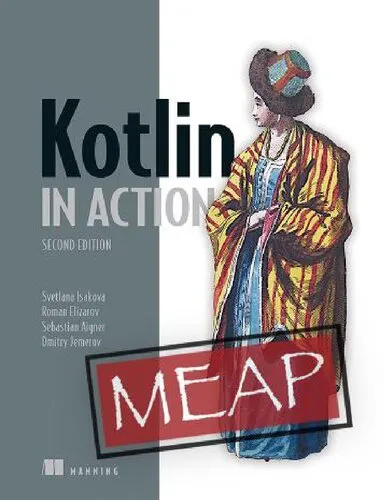
Kotlin in Action, Second Edition (MEAP V09)
Svetlana Isakova,Roman Elizarov,Sebastian Aigner,Dmitry Jemerov
2023
View book
Book guide and evaluation
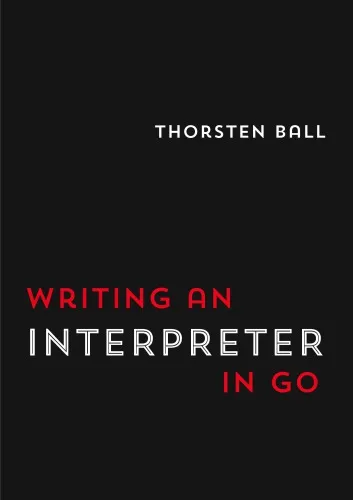
Thorsten Ball
0 reviews
Published
pages
views
Welcome to an enthralling journey into the world of programming language architecture with 'Writing an Interpreter in Go'. This book serves as a comprehensive guide for seasoned developers and enthusiasts eager to delve into interpreter creation, using the Go programming lang
Before you read
Welcome to an enthralling journey into the world of programming language architecture with 'Writing an Interpreter in Go'. This book serves as a comprehensive guide for seasoned developers and enthusiasts eager to delve into interpreter creation, using the Go programming language as their canvas.
In 'Writing an Interpreter in Go', you embark on an educational journey to construct a fully-functional interpreter for a small, dynamic programming language. The book carefully breaks down the intricate process into digestible steps, making the complex art of interpreter building both accessible and engaging. Beginning with the very fundamentals, you learn to lexically analyze input strings and generate tokens that form the bedrock of our interpretation. From tokenization, the narrative advances into pushing you through the realms of parsing, where syntax trees are born and nurtured.
This journey doesn't stop at just structuring trees and interpreting them; it culminates in executing your own language, understanding variables, and functions, adding depth with control flow mechanisms like conditionals and loops. As if that wasn't compelling enough, the book finalizes the exploration with advanced topics such as building a REPL (Read-Eval-Print-Loop) and implementing closures and first-class functions, all the while maintaining a clear focus on simplicity, readability, and maintaining Go's idiomatic style.
"Understanding how interpreters work gives you insight into how languages behave at a fundamental level, enlightening even your day-to-day coding tasks with newfound clarity."
"The journey of writing your own language tool breathes life into abstract theories, transforming them into tangible, working constructs of logic and creativity."
The relevance of 'Writing an Interpreter in Go' stretches beyond mere academic exercise. In a world increasingly driven by technology, understanding the building blocks of programming languages equips you with a powerful skill set. This book not only exposes the inner workings of interpreters but also provides expertise in Go, a language known for its efficiency, simplicity, and robustness.
Furthermore, the hands-on approach taken by the book ensures that programming language theory doesn't just remain theory. It lives and breathes through the interpreter you build, giving you an authentic taste of real-world programming language creation and problem-solving. Whether you are a curious developer, a language enthusiast, or someone keen on broadening their programming horizons, this book empowers you to craft your own tools and understand, on a profound level, the languages you use every day.
Your question is answered in the context of this title and author. Each answer uses 2 points.
0 reviews, 4.7 average out of 5
Sign in to publish a review.
Ask a focused question and learn from the community.
Related references that continue this learning path.
Svetlana Isakova,Roman Elizarov,Sebastian Aigner,Dmitry Jemerov
Rumeel Hussain,Maryam Zulfiqar