Book guide and evaluation
World Englishes
Fred Davidson
English
Unordered
Language Learning
4.7 / 5
0 reviews
1994 March
Published
369
pages
127
views
World Englishespp.119—120 Global language diversity, English in sociolinguistic contexts Explore World Englishespp.119—120 for insights into global English variations and their cultural impact. Analytical Summary The section spanning pages 119—120 in World English
Before you read
What will you get from this book?
Analytical Summary
The section spanning pages 119—120 in World Englishespp.119—120 provides a focused exploration of how English has evolved into a multitude of localized forms across the globe, reflecting complex social, political, and cultural dynamics. It serves as a microcosm of the book’s broader ambition: to examine English not as a monolithic entity, but as a diverse set of linguistic realities tailored to the needs and identities of its speakers.
Within these pages, readers encounter analyses that bridge linguistics and cultural studies. This portion of the book addresses how English adapts in various sociolinguistic contexts, exploring factors such as colonial history, post-colonial identity formation, and globalization. The discussion emphasizes the interplay between language policy and everyday communication, highlighting the ways in which English continues to be reshaped by communities around the world.
Designed for academics, professionals, and serious enthusiasts in linguistics and intercultural communication, this section offers both theoretical grounding and practical insight. The treatment is precise yet accessible, ensuring that readers from multiple disciplines can engage meaningfully with the concepts.
Key Takeaways
From these pages, a set of key insights emerges—each one pointing toward a deeper understanding of global language diversity and the role of English within it.
First, English exists in multiple legitimate forms, each carrying the imprint of its local culture.
Second, sociopolitical history profoundly shapes how English is used and perceived in different regions.
Third, for professionals in language policy and education, acknowledging these diverse forms is crucial for effective communication.
Fourth, a recognition of local varieties can help dismantle hierarchies that position certain forms of English as “superior.”
Finally, ongoing change means that English will continue to diversify, requiring continuous scholarly engagement.
Memorable Quotes
“English is not owned by any one nation; it is a shared resource reshaped by countless voices.”Unknown
“Variety in language reflects variety in culture, and both deserve equal respect.”Unknown
“Understanding World Englishes is understanding the world itself.”Unknown
Why This Book Matters
World Englishespp.119—120 is not merely a textual analysis; it is a call to rethink entrenched ideas about what constitutes “proper” English.
For educators, policymakers, and linguists, the insights here help refine approaches to curriculum design, translation services, and international collaboration. The section’s emphasis on sociolinguistic contexts brings a fresh urgency to discussions about language equity in global communication.
Information unavailable regarding publication year or any awards, as no reliable public source currently provides these details. Nevertheless, the book’s resonance lies in its enduring relevance: acknowledging English’s many forms helps foster mutual respect among culturally diverse speakers.
Inspiring Conclusion
Engaging with World Englishespp.119—120 offers more than academic enrichment; it opens a door to seeing English as a living, evolving tapestry woven from the experiences of its speakers worldwide.
For scholars and professionals alike, these pages provide a framework for approaching English with both analytical rigor and cultural sensitivity. They remind us that language is both a tool and a mirror—shaping and reflecting the societies that use it.
Your next step is clear: read, share, and discuss the perspectives presented here. In doing so, you contribute to a more informed, respectful, and collaborative global dialogue about the English language and its many voices.
Ask this book
Your question is answered in the context of this title and author. Each answer uses 2 points.
Sign in to ask the book assistant.
Reader reviews
0 reviews, 4.7 average out of 5
No reviews yet
If you have read this book, help the next reader with your experience.
Write a review
Sign in to publish a review.
Reader questions and answers
Ask a focused question and learn from the community.
Sign in to ask or answer a question.
No questions yet
Be the first to ask a clear, useful question.
What to read next
Related references that continue this learning path.
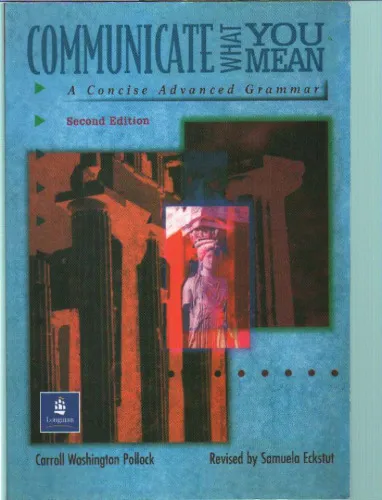
Communicate What You Mean: A Concise Advanced Grammar
Carroll Washington Pollock, Samuela Eckstut
1997
View book