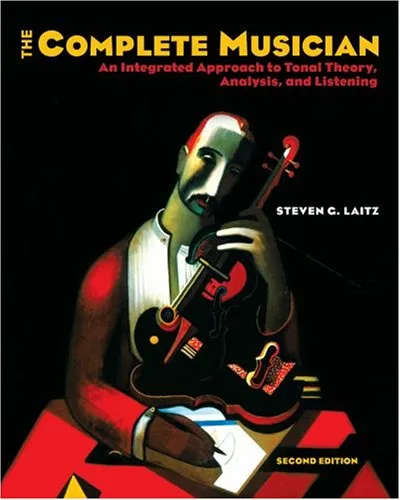
The complete musician: an integrated approach to tonal theory, analysis, and listening
Steven Geoffrey Laitz
2008
View book

Book guide and evaluation
Edward Aldwell;Carl Schachter
0 reviews
Published
pages
views
Introduction to "Workbook: Harmony And Voice Leading" "Workbook: Harmony And Voice Leading" is a comprehensive and meticulously crafted companion to the main textbook "Harmony and Voice Leading," authored by Edward Aldwell and Carl Schachter. Designed for music students, educa
Before you read
"Workbook: Harmony And Voice Leading" is a comprehensive and meticulously crafted companion to the main textbook "Harmony and Voice Leading," authored by Edward Aldwell and Carl Schachter. Designed for music students, educators, and enthusiasts alike, this workbook offers a hands-on approach to understanding the intricate relationships between harmony, counterpoint, and melodic structure. Spanning a variety of exercises and examples, the text transforms theoretical concepts into practical applications, ensuring mastery of the material at every step.
Whether you're studying classical harmony or are new to music theory, this workbook serves as an invaluable tool to develop your skills in composition, analysis, and critical listening.
The "Workbook: Harmony And Voice Leading" is designed to reinforce and expand upon the lessons covered in the main textbook. The workbook comprises a series of carefully structured exercises that address key topics in tonal harmony, such as chord progressions, voice leading, species counterpoint, part-writing, modulation, phrase structure, and chromatic harmony. Each chapter corresponds to the theoretical material covered in the primary text, allowing students to apply what they've learned in a meaningful and engaging way.
In each exercise, readers are tasked with tasks such as analyzing scores, completing partially written musical examples, correcting errors, or composing original phrases of their own. The goal is not simply to answer the questions but to internalize the principles that govern tonal music. Additionally, the workbook provides opportunities to grapple with the real music of great composers, bringing theoretical discussions to life by emphasizing their relevance to practical musical contexts.
The gradual progression of difficulty ensures that students feel encouraged and challenged, regardless of their level of prior knowledge. With consistent practice, this workbook supports learners in developing their fluency and intuition for 18th- and 19th-century harmonic practices.
While "Workbook: Harmony And Voice Leading" is primarily an instructional book rather than a literary one, its teachings are echoed in its parent text. Some memorable quotes and themes that resonate include:
"Music is not just written sound, but a sequence of logical events governed by a set of principles."
"The interplay of counterpoint and harmony lies at the heart of tonal music."
"Harmony only becomes meaningful when coupled with the art of voice leading."
For anyone seeking a deeper understanding of tonal music, the "Workbook: Harmony And Voice Leading" is an essential resource. By bridging the gap between abstract theory and hands-on practice, it equips learners with the tools they need to engage critically and creatively with music. More than just a workbook, it represents a disciplined and structured approach to mastering one of music's most enduring traditions.
The book's methodical guidance has made it an enduring classic in music theory education. It underscores the relevance of harmonic principles to music-making, regardless of genre, and fosters a deeper appreciation for the inner workings of music. By working through its exercises, students are empowered to develop their analytical and compositional skills, laying the groundwork for further studies in areas like orchestration, conducting, and music history.
At a time when traditional methods of music education face constant evolution, this workbook remains a cornerstone text that satisfies both intellectual curiosity and the practical demands of aspiring musicians. Its timeless approach ensures its value for generations of learners to come.
Your question is answered in the context of this title and author. Each answer uses 2 points.
0 reviews, 4.5 average out of 5
Sign in to publish a review.
Ask a focused question and learn from the community.
Related references that continue this learning path.
Steven Geoffrey Laitz