
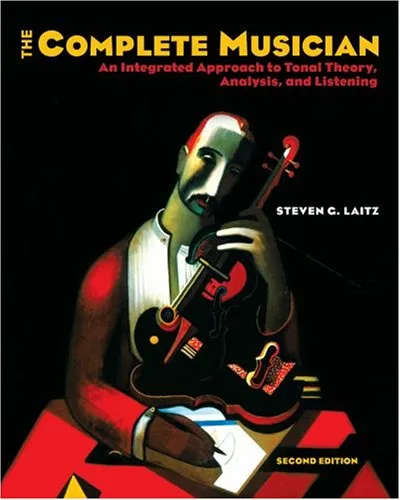
The complete musician: an integrated approach to tonal theory, analysis, and listening
Steven Geoffrey Laitz
2008
View book

Book guide and evaluation
Stefan Kostka,Dorothy Payne
0 reviews
Published
pages
views
Introduction to Workbook for Tonal Harmony: With an Introduction to Twentieth-Century Music, 5th Edition Welcome to the Workbook for Tonal Harmony: With an Introduction to Twentieth-Century Music, 5th Edition, a carefully designed companion to one of the most respected tex
Before you read
Welcome to the Workbook for Tonal Harmony: With an Introduction to Twentieth-Century Music, 5th Edition, a carefully designed companion to one of the most respected texts in music theory. This workbook has been crafted to deepen your understanding of tonal harmony, providing practical exercises to reinforce theoretical concepts and bridge the gap between learning and application. Whether you're a music student, educator, or enthusiast, this guide is here to support you in mastering the foundations of tonal music as well as easing your exploration into 20th-century musical ideas.
Across its meticulously curated chapters, this workbook integrates theoretical frameworks, hands-on exercises, and approachable explanations to make even the most complex musical concepts accessible. From simple harmonic structures to the challenging yet thrilling innovations of modern music, this workbook ensures that students are not only competent but confident in their musical studies.
The Workbook for Tonal Harmony is a practical extension of the main textbook, designed to complement its theoretical insights with exercises that immerse students in the foundational principles of tonal music. Each chapter corresponds directly to a section of the main textbook, enhancing your understanding through practice and experimentation.
In the first sections, the workbook covers the basics of musical notation, intervals, triads, and seventh chords. Gradually, it introduces more advanced topics such as voice leading, harmonic progressions, secondary dominants, and chromaticism. A particular highlight is its focus on analysis and composition, helping learners connect theoretical knowledge with real-life music application.
Toward the end of the workbook, the discussion shifts to 20th-century music, a time when traditional tonal harmony encountered radical transformations. This allows students to explore concepts like modal interchange, atonality, and twelve-tone techniques, offering a well-rounded view of the rich and evolving language of music.
"Music is governed by rules, but those rules are tools for expression, not barriers to creativity."
"Part-writing is not merely a technical exercise; it is the foundation for communicating harmony with clarity and beauty."
"From Bach to Schoenberg, the study of harmony is a window into how people expressed their emotions, beliefs, and ideas through music."
The Workbook for Tonal Harmony is much more than an academic text; it is a gateway to understanding one of the most crucial elements of Western music: tonal harmony. Anyone who aspires to play, compose, or analyze music can benefit from the clear and structured exercises provided in this workbook. The inclusion of 20th-century techniques ensures that learners are equipped with the tools to understand both historical and modern music.
Furthermore, this workbook stands out because of its practicality. Unlike many theoretical books, it emphasizes active learning through structured but flexible exercises. Students leave this course of study not only with knowledge but also with the skills to apply that knowledge in diverse musical contexts. Its commitment to clarity, structure, and depth makes it an invaluable resource in the field of music education.
By presenting a logical progression from basic to advanced topics, the workbook encourages steady yet challenging growth. Overall, it inspires a lifelong appreciation for music theory while fostering the creative potential of every reader.
Your question is answered in the context of this title and author. Each answer uses 2 points.
0 reviews, 4.6 average out of 5
Sign in to publish a review.
Ask a focused question and learn from the community.
Related references that continue this learning path.
Steven Geoffrey Laitz

Stefan Kostka,Dorothy Payne,Allan Schindler
