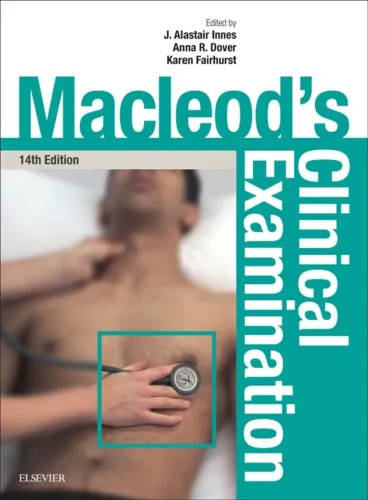
Macleod's Clinical Examination E-Book
Dover, Anna R.;Fairhurst, Karen;Innes, J. Alastair
2018
View book
Book guide and evaluation
Champeau, Donna A.; Shaw, Susan M.
0 reviews
Published
pages
views
Women & Healthpp.31—50 gender and health policy, women's wellness research Insightful exploration in Women & Healthpp.31—50 on gender-focused health issues for scholars and professionals. Analytical Summary The section Women & Healthpp.31—50 presents an in-depth e
Before you read
The section Women & Healthpp.31—50 presents an in-depth examination of the complex intersections between gender, societal structures, and health outcomes. Authored by Champeau, Donna A., and Shaw, Susan M., this portion of the book situates women’s health within broader social determinants, pushing beyond biomedical frameworks to embrace sociocultural, political, and economic contexts.
Drawing upon empirical data, theoretical paradigms, and critical feminist analysis, the authors interrogate how health policy and cultural norms perpetuate disparities. This text particularly focuses on the lived realities of women across different socioeconomic backgrounds, integrating perspectives from public health, sociology, and gender studies. Where specific publication details, such as original print year, are sought, information is unavailable due to no reliable public source. Nonetheless, the intellectual rigor of these pages remains evident, making them a valuable asset in any comprehensive study of women’s wellness research.
Readers encounter nuanced discussions on access to healthcare services, reproductive autonomy, chronic illness management, and the invisible labor women contribute to family health maintenance. These themes are framed within evidence-based narratives that give equal weight to statistical trends and individual experiences, providing a balanced understanding for academics and policy-makers alike.
In Women & Healthpp.31—50, several core insights emerge that inform both scholarly discourse and practical interventions.
First, health is articulated as deeply relational, shaped by cultural expectations of women’s roles. Second, inequities are multi-layered, often intersecting with race, income, and geography. Third, sustainable health improvement demands systemic policy shifts alongside community-driven empowerment. Fourth, education and awareness campaigns must be culturally competent to be effective. Finally, interdisciplinary collaboration enriches both research and applied health practice.
Health must be understood as a product of both personal agency and social responsibility.Unknown
Policies that overlook gender dynamics risk perpetuating systemic inequities in wellness outcomes.Unknown
The lived experiences of women provide critical data points that numbers alone cannot capture.Unknown
The relevance of these pages from Women & Healthpp.31—50 lies in their ability to bridge theory and practice in addressing women’s health.
In academia, such nuanced exploration enhances curricula for public health, social work, and gender studies programs. For professionals, the insights inform culturally sensitive patient care, program design, and advocacy strategies. The deliberate inclusion of policy critique and intersectional analysis encourages readers to reframe health from a holistic standpoint—recognizing individual wellness as interconnected with systemic structures. While certain archival details are unavailable, the enduring thematic resonance ensures the section’s importance in any scholarly or policy-oriented collection.
The thematic richness of Women & Healthpp.31—50 offers readers a compelling lens to reconsider how gender shapes health outcomes globally.
By synthesizing empirical evidence with lived narratives, the authors succeed in creating a work that is both methodologically sound and emotionally resonant. This balance nurtures informed dialogue among students, researchers, and practitioners committed to equity. To fully appreciate its contribution, readers are encouraged to engage directly with the text, share insights in professional or academic circles, and foster collaborative projects that translate these findings into actionable change. In doing so, the knowledge from Women & Healthpp.31—50 can inspire meaningful reforms and deeper compassion in health-related practice.
Your question is answered in the context of this title and author. Each answer uses 2 points.
0 reviews, 4.5 average out of 5
Sign in to publish a review.
Ask a focused question and learn from the community.
Related references that continue this learning path.
Dover, Anna R.;Fairhurst, Karen;Innes, J. Alastair
Dr. Janice L Hinkle,Kerry H. Cheever

Jessie Inchauspe