Book guide and evaluation
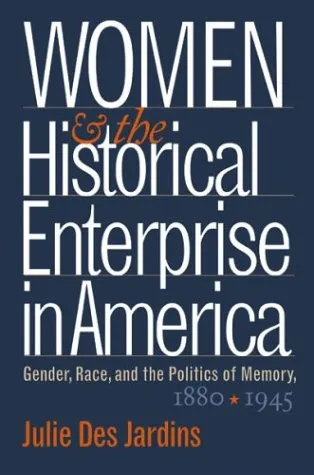
Women and the Historical Enterprise in America: Gender, Race, and the Politics of Memory, 1880-1945 (Gender and American Culture)
Julie Des Jardins
English
Intermediate
novel
4.6 / 5
0 reviews
2003
Published
397
pages
379
views
Women and the Historical Enterprise in America: Gender, Race, and the Politics of Memory, 1880-1945 (Gender and American Culture) gender and historiography, women's roles in shaping historical memory Explores how women shaped historical memory in America, 1880–1945, in
Before you read
What will you get from this book?
Analytical Summary
Written with scholarly precision and deep cultural insight, Women and the Historical Enterprise in America: Gender, Race, and the Politics of Memory, 1880-1945 (Gender and American Culture) investigates the overlooked contributions of women to the historical profession and public history in the United States during a transformative period in the nation’s development.
This book examines the intersections of gender, race, and the politics of historical memory, situating female historians, archivists, educators, and preservationists within a larger framework of the historical enterprise. While male historians often dominated academic institutions in the late 19th and early 20th centuries, women developed parallel structures for sharing and preserving history—through local historical societies, school curricula, museum work, and activism in preservation movements.
By weaving together personal narratives, institutional histories, and critical theory, the work reveals how women's historical contributions were shaped by the racial and gender norms of their time. It also underscores how their efforts often contested exclusionary narratives, positioning marginalized voices within the national story. Through a careful reading of archival sources, public speeches, and publications of the era, the book illuminates the varied strategies women employed to assert authority over historical interpretation.
Key Takeaways
This volume is not only an academic contribution but also a roadmap to understanding how historical narratives are formed, challenged, and revised through the work of diverse actors.
Readers will grasp how women's engagement in the historical enterprise reshaped American historiography during a time when professional history was consolidating its methods and institutions.
The interplay between race and gender emerges as a critical factor, revealing patterns of inclusion and exclusion in historical representation.
The book demonstrates the breadth of women's involvement—from grassroots local history projects to national preservation campaigns—and their lasting influence on public memory.
It offers insight into the constraints placed on women’s historical work, and how these scholars and activists navigated structures that privileged certain narratives over others.
Memorable Quotes
"Historical memory is constructed not only in libraries and archives but in everyday activism." Unknown
"Women's contributions to history are often hidden in plain sight, embedded in the cultural fabric they helped to weave." Unknown
"To understand the past fully, we must examine who gets to tell its story and why." Unknown
Why This Book Matters
This scholarly examination fills a critical gap in historiography by integrating gender and race into the analysis of how history is produced and remembered.
For academics, this volume offers a nuanced lens through which to reconsider established historical narratives. For professionals in museum and archival work, it serves as a reminder of the diverse forces shaping collective memory.
By centering women—both white and women of color—in the historical enterprise between 1880 and 1945, the book expands our understanding of what counts as historical labor and who performs it.
Its contributions resonate beyond the academy, inviting dialogue among educators, preservationists, and cultural institutions seeking a fuller account of the past.
Inspiring Conclusion
In revisiting the years between 1880 and 1945, Women and the Historical Enterprise in America: Gender, Race, and the Politics of Memory, 1880-1945 (Gender and American Culture) urges readers to interrogate who shapes the historical canon and whose voices still fight for recognition.
Whether you are a historian, cultural worker, educator, or engaged citizen, this work invites you to reconsider the foundations of historical memory and to actively contribute to its democratization. By examining the intersections of gender and race, the book highlights the transformative power of inclusive scholarship.
Read, share, and discuss this vital text with colleagues and students, allowing its insights to inform your own approach to history-making. The invitation is clear: join in broadening the historical enterprise to ensure the past reflects the richness and complexity of the human experience.
Ask this book
Your question is answered in the context of this title and author. Each answer uses 2 points.
Sign in to ask the book assistant.
Reader reviews
0 reviews, 4.6 average out of 5
No reviews yet
If you have read this book, help the next reader with your experience.
Write a review
Sign in to publish a review.
Reader questions and answers
Ask a focused question and learn from the community.
Sign in to ask or answer a question.
No questions yet
Be the first to ask a clear, useful question.
What to read next
Related references that continue this learning path.
The Well-Educated Mind: A Guide to the Classical Education You Never Had
Susan Wise Bauer
2003
View book