
Book guide and evaluation
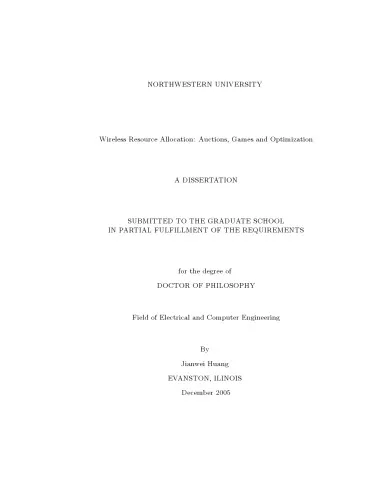
Wireless Resource Allocation: Auctions, Games and Optimization Ph.D Thesis
Jianwei Huang
English
Beginner
Art
4.4 / 5
0 reviews
-
Published
271
pages
204
views
Introduction to 'Wireless Resource Allocation: Auctions, Games, and Optimization Ph.D Thesis' The book 'Wireless Resource Allocation: Auctions, Games and Optimization Ph.D Thesis' is a pioneering contribution to the field of wireless communications and networks, authored to
Before you read
What will you get from this book?
Introduction to 'Wireless Resource Allocation: Auctions, Games, and Optimization Ph.D Thesis'
The book 'Wireless Resource Allocation: Auctions, Games and Optimization Ph.D Thesis' is a pioneering contribution to the field of wireless communications and networks, authored to explore and advance the sophisticated techniques necessary for efficiently managing and optimizing limited wireless resources. In the rapidly expanding domain of wireless technologies, resource allocation remains a cornerstone of performance optimization and reliability. This work comprehensively integrates principles from economic theory, game theory, and mathematical optimization with a focus on practical applications in wireless systems.
Detailed Summary of the Book
The thesis is built on the premise that wireless communication networks face escalating challenges due to the explosive growth of mobile devices, emerging technologies like 5G and IoT, and finite spectrum resources. Hence, efficient allocation of resources such as bandwidth and power plays a pivotal role in ensuring seamless connectivity, scalability, and quality of service.
The book is structured around three key methodologies:
- Auctions: Mechanism design frameworks, inspired by economics, are used to allocate resources in a competitive yet efficient manner. Practical auction schemes and their application to real-world scenarios such as spectrum auctioning and shared access are thoroughly examined.
- Games: Game-theoretical approaches highlight strategic decision-making processes among network entities, including users and service providers. The book integrates concepts such as Nash equilibrium, Stackelberg games, and bargaining to solve resource conflicts and encourage cooperative behaviors.
- Optimization: It delves into mathematical optimization techniques, such as convex optimization and dual decomposition, to resolve resource allocation problems analytically. These techniques are applied to power control, user association, and interference management in modern wireless systems.
Each approach is supplemented with mathematical models, detailed numerical examples, and real-world case studies to offer comprehensive insights into their theoretical underpinnings and practical applicability.
Key Takeaways
- A thorough understanding of the role auctions, game theory, and optimization techniques play in wireless networks.
- Insight into achieving fairness, efficiency, and scalability in resource allocation amidst competing demands and limited spectrum availability.
- Practical frameworks to mitigate interference, optimize power consumption, and enhance data rates in modern communication systems.
- Step-by-step derivations of theoretical models alongside code-ready algorithms for real-world implementation.
Famous Quotes from the Book
"Fairness in resource allocation is not synonymous with equality—it is about enabling users to achieve maximum efficiency under their unique constraints."
"The intersection of economics and engineering is where the key to solving many resource optimization problems lies."
Why This Book Matters
In an era dominated by smartphones, IoT devices, and 5G networks, the demand for efficient spectrum utilization is unprecedented. This book provides an indispensable framework for professionals, researchers, and students aiming to bridge the gap between theory and practice in wireless communications. By leveraging multi-disciplinary concepts from engineering, mathematics, and economics, the book delivers innovative solutions to the most pressing problems in wireless resource allocation.
Furthermore, this thesis is not just a theoretical endeavor—it is a practical guide that has shaped contemporary wireless systems and standards. Its methodologies serve as a cornerstone for designing the next generation of communication technologies, equipping readers to address challenges that arise with the evolution of 6G and beyond.
Ask this book
Your question is answered in the context of this title and author. Each answer uses 2 points.
Sign in to ask the book assistant.
Reader reviews
0 reviews, 4.4 average out of 5
No reviews yet
If you have read this book, help the next reader with your experience.
Write a review
Sign in to publish a review.
Reader questions and answers
Ask a focused question and learn from the community.
Sign in to ask or answer a question.
No questions yet
Be the first to ask a clear, useful question.
What to read next
Related references that continue this learning path.

Modern Computer Vision with PyTorch: A Practical Roadmap From Deep Learning Fundamentals to Advanced Applications and Generative AI, 2nd Edition
V Kishore Ayyadevara,Yeshwanth Reddy
2023
View book