
Book guide and evaluation
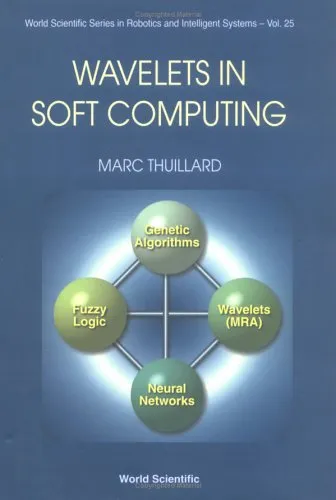
Wavelets in Soft Computing (World Scientific Series in Robotics and Intelligent Systems, 25)
Marc Thuillard
English
Beginner
Software Engineering
4.8 / 5
0 reviews
2001
Published
246
pages
176
views
Introduction to "Wavelets in Soft Computing" "Wavelets in Soft Computing" is part of the acclaimed World Scientific Series in Robotics and Intelligent Systems and offers an in-depth exploration of wavelet theory and its integration into the realm of soft computing methods.
Before you read
What will you get from this book?
Introduction to "Wavelets in Soft Computing"
"Wavelets in Soft Computing" is part of the acclaimed World Scientific Series in Robotics and Intelligent Systems and offers an in-depth exploration of wavelet theory and its integration into the realm of soft computing methods. Authored by Marc Thuillard, the book aims to bridge the gap between the theoretical foundations of wavelets and their practical applications in the rapidly evolving fields of intelligent computation, artificial intelligence, and robotics.
Wavelets have taken center stage in computational science due to their versatility in representing data with high precision, particularly when dealing with irregularities or anomalies. Combining this powerful mathematical tool with the principles of soft computing—such as neural networks, fuzzy logic, and genetic algorithms—unlocks new opportunities in solving complex, real-world problems with better accuracy and reduced computational costs. With examples drawn from various industries, the book highlights how the fusion of these two domains can lead to groundbreaking innovations while remaining accessible to a diverse audience.
Detailed Summary of the Book
The book is structured to provide a holistic understanding of wavelets and their applications. Divided into several chapters, the content gradually builds the reader's knowledge base, from basic concepts to advanced implementations. The journey begins with an introductory overview of wavelet mathematics, including their transformation properties, multi-resolution analysis, and relevance to signal processing. The author methodically explains how wavelets outperform traditional Fourier methods, particularly in non-stationary signal analysis.
The subsequent chapters delve into the interplay between wavelets and soft computing approaches. For example, the book illustrates how wavelets enhance fuzzy logic's adaptability to noisy data sets or how wavelet-based preprocessing improves the performance of neural networks in classification tasks. Real-world case studies, spanning fields like image compression, speech recognition, pattern analysis, and financial forecasting, are presented to showcase the practical applications of these hybrid techniques.
Furthermore, the author emphasizes the use of genetic algorithms for optimizing wavelet-based systems and explores emerging paradigms like wavelet-based hybrid models. The balance of mathematical rigor and practical insights ensures that the book caters to both academia and professionals in engineering, robotics, and data science.
Key Takeaways
- A clear and comprehensive introduction to wavelet theory and multi-resolution analysis.
- Insights into combining wavelets with soft computing methods, including neural networks, fuzzy logic, and genetic algorithms.
- Step-by-step exploration of hybrid applications in domains like image processing, robotics, and financial modeling.
- Practical examples and case studies that bridge the gap between theory and application.
- One of the first books to emphasize the role of wavelets in soft computing while maintaining accessibility to a wider audience.
Famous Quotes from the Book
"Wavelets are not just tools for computation; they are languages that decode the hidden structures in data, revealing patterns invisible to classical methods."
"The fusion of wavelet theory and soft computing principles is not merely a combination—it is a revolution in the way we solve complex, dynamic problems."
Why This Book Matters
The relevance of "Wavelets in Soft Computing" extends far beyond its theoretical contributions. As industries and academic fields increasingly rely on data-intensive methods, wavelets present a highly efficient solution for analyzing, compressing, and reconstructing information. In today's world of big data, artificial intelligence, and robotics, the ability to process complex, irregular data sets is a critical advantage. This is where the book excels—it not only demystifies wavelet theory for beginners but also offers advanced insights for seasoned practitioners seeking innovation.
Marc Thuillard's expertise and ability to articulate complex concepts in an approachable manner make this book an indispensable resource for students, researchers, and professionals alike. Whether you are exploring signal processing, artificial intelligence, or any domain involving advanced computation, this book lays the groundwork for future trends and provides tools that can be applied directly to real-world challenges.
For researchers and engineers looking to tackle cutting-edge problems, the hybrid approaches presented in this book act as a beacon of innovation. The seamless integration of wavelet techniques with soft computing methods is a testament to the interdisciplinary nature of modern problem-solving. This makes "Wavelets in Soft Computing" an essential addition to the library of anyone working at the intersection of mathematics, computer science, and engineering.
Ask this book
Your question is answered in the context of this title and author. Each answer uses 2 points.
Sign in to ask the book assistant.
Reader reviews
0 reviews, 4.8 average out of 5
No reviews yet
If you have read this book, help the next reader with your experience.
Write a review
Sign in to publish a review.
Reader questions and answers
Ask a focused question and learn from the community.
Sign in to ask or answer a question.
No questions yet
Be the first to ask a clear, useful question.
What to read next
Related references that continue this learning path.
Modern Computer Vision with PyTorch: A Practical Roadmap From Deep Learning Fundamentals to Advanced Applications and Generative AI, 2nd Edition
V Kishore Ayyadevara,Yeshwanth Reddy
2023
View book