

Book guide and evaluation
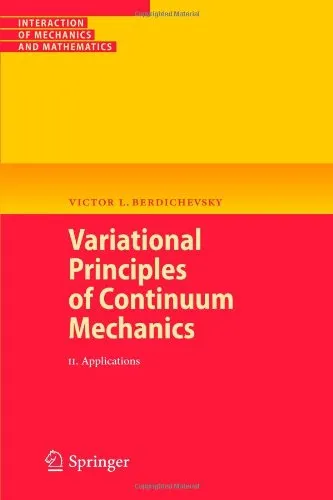
Variational Principles of Continuum Mechanics: II. Applications
Victor Berdichevsky (auth.)
English
Beginner
Physics
4.3 / 5
0 reviews
2009
Published
431
pages
313
views
Introduction to "Variational Principles of Continuum Mechanics: II. Applications" "Variational Principles of Continuum Mechanics: II. Applications" is a comprehensive exploration of how variational principles are applied to solve intricate problems in continuum mechanics. Au
Before you read
What will you get from this book?
Introduction to "Variational Principles of Continuum Mechanics: II. Applications"
"Variational Principles of Continuum Mechanics: II. Applications" is a comprehensive exploration of how variational principles are applied to solve intricate problems in continuum mechanics. Authored by Victor Berdichevsky, this second volume serves as a practical companion to the theoretical foundations discussed in the first book, bridging the gap between abstract principles and real-world applications.
This volume is a vital resource for scientists, engineers, and researchers who deal with complex mechanical systems. It delves into the mathematical rigor of variational principles while making their application accessible and transformative for understanding physical phenomena. Whether you are a student building foundational knowledge or a professional looking to apply advanced methods, this text will guide you through numerous applications that highlight the true power of variational approaches.
1. Detailed Summary of the Book
The book opens with a concise introduction to the variational methods that underpin continuum mechanics and progresses toward their application in diverse fields. The subjects covered range from classical elasticity and fluid mechanics to more modern disciplines such as nonlinear dynamics and thermomechanics.
The main focus of the book is on analyzing a wide array of physical problems using variational principles. By unifying different branches of continuum mechanics, the text provides a clear roadmap for applying these sophisticated mathematical tools to real phenomena. It emphasizes major topics such as:
- The principle of stationary action in mechanics and connections to energy methods.
- Applications in elasticity, plasticity, and fracture mechanics.
- Fluid flow phenomena, turbulence modeling, and stability analysis.
- Thermodynamic principles and their integration with continuum systems.
- Nonlinear systems and their variational formulations.
The book is structured to provide step-by-step problem-solving techniques, supplemented by insightful examples. By tying mathematical rigor directly to physical cases, it equips the reader with tools to tackle challenges in areas like material science, structural analysis, and environmental systems.
2. Key Takeaways
This book distills years of research and teaching experience into actionable knowledge. Here are the key takeaways:
- An in-depth understanding of the variational principles that form the backbone of continuum mechanics.
- Comprehensive coverage of practical applications in elasticity, fluid dynamics, and material behavior.
- A clear demonstration of how theory translates into solving real-world mechanical problems.
- Enhanced confidence in using mathematical approaches to analyze nonlinear systems and their stability.
- Practical examples and problem-solving strategies that make the abstract concrete.
3. Famous Quotes from the Book
Some powerful insights from the book:
“The true beauty of variational principles lies in their universal applicability, simplifying even the most complex physical systems to their essential elements.”
“Mechanics thrives at the intersection of mathematics and physics, where variational methods are the guiding compass.”
“To solve is to systematize—variational principles offer a structured way to navigate the chaos of real-world phenomena.”
4. Why This Book Matters
"Variational Principles of Continuum Mechanics: II. Applications" is more than just a textbook; it is a critical contribution to the scientific understanding of mechanical systems.
The value of this book lies in its ability to unify decades of theoretical advancements into an accessible, application-oriented framework. In fields such as engineering, physics, and applied mathematics, variational principles have brought breakthroughs repeatedly. This text identifies those breakthroughs, presenting them in a way that fosters deeper thinking and innovation.
In a world where modern challenges demand interdisciplinary solutions, the methodology presented in this book becomes highly relevant. Engineers designing more resilient materials, theorists creating models for energy-efficient systems, or researchers analyzing the nonlinearity of natural phenomena will find unparalleled guidance and inspiration. Its clarity and practical focus ensure its place as a critical resource for anyone engaged in advancing the frontiers of continuum mechanics.
Ultimately, this book matters because it transforms what might seem like an overwhelming mathematical framework into a toolset that empowers readers to address pressing mechanical and physical challenges in innovative ways.
Ask this book
Your question is answered in the context of this title and author. Each answer uses 2 points.
Sign in to ask the book assistant.
Reader reviews
0 reviews, 4.3 average out of 5
No reviews yet
If you have read this book, help the next reader with your experience.
Write a review
Sign in to publish a review.
Reader questions and answers
Ask a focused question and learn from the community.
Sign in to ask or answer a question.
No questions yet
Be the first to ask a clear, useful question.
What to read next
Related references that continue this learning path.


Modern Computer Vision with PyTorch: A Practical Roadmap From Deep Learning Fundamentals to Advanced Applications and Generative AI, 2nd Edition
V Kishore Ayyadevara,Yeshwanth Reddy
2023
View book