

Book guide and evaluation
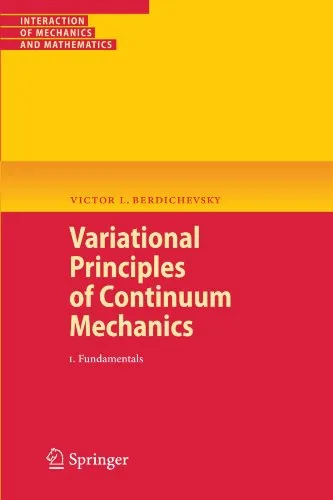
Variational Principles of Continuum Mechanics: I. Fundamentals
Victor Berdichevsky (auth.)
English
Beginner
Physics
4.2 / 5
0 reviews
2009
Published
587
pages
332
views
Introduction to "Variational Principles of Continuum Mechanics: I. Fundamentals" The book "Variational Principles of Continuum Mechanics: I. Fundamentals", authored by Victor Berdichevsky, is a captivating exploration of the foundations of continuum mechanics based
Before you read
What will you get from this book?
Introduction to "Variational Principles of Continuum Mechanics: I. Fundamentals"
The book "Variational Principles of Continuum Mechanics: I. Fundamentals", authored by Victor Berdichevsky, is a captivating exploration of the foundations of continuum mechanics based on variational principles. Aimed at advancing the reader's understanding of mechanics' theoretical structure, this book dives into the mathematical rigor and physical intuition necessary to grasp the subject.
Continuum mechanics studies the behavior of materials that appear continuous rather than discrete at every scale of interest. This field is indispensable in engineering, physics, and applied mathematics. By framing this subject using variational principles, the book illuminates deeper symmetries and conservation laws of physical systems.
In this book, readers are introduced to foundational methods in mechanics, refined tools from advanced mathematics, and a systematic methodology to address complex physical systems. It serves as both a rigorous theoretical reference and a practical guide for students, scientists, and engineers eager to master variational approaches. Through clear mathematical formulation and illustrative examples, this volume fosters a solid understanding of continuum mechanics and its application to various domains.
Detailed Summary of the Book
The book systematically explores the discipline of continuum mechanics through the lens of variational principles, starting with the foundational ideas of mechanics and moving toward their application in continuum systems. The content is segregated into key parts designed for clarity and progressive comprehension. Initially, the principles of classical mechanics are reviewed, laying the groundwork for applying energy-based approaches to describe physical systems.
Emphasis is placed on the Lagrangian and Hamiltonian formulations, which are cornerstone methods in deriving fundamental equations for dynamics and material behavior. The book then delves into the calculus of variations, highlighting its utility in solving problems in elasticity, fluid dynamics, and thermodynamics. Throughout, the text provides rigorous derivations, clear explanations, and ample examples to bridge theory with practical understanding.
Additionally, the text addresses the intrinsic links between symmetry properties of physical laws and conservation principles, such as energy, momentum, and angular momentum. Readers are also guided through higher-level concepts, including nonlinear phenomena, stability analysis, and multi-scale mechanics.
By the end of the book, readers are expected to have a strong grasp of variational methods and their application to real-world physical systems, offering valuable tools for both research and practical engineering applications.
Key Takeaways
- Comprehensive introduction to continuum mechanics through variational principles.
- Detailed explanations of the Lagrangian and Hamiltonian formulations for mechanical systems.
- Insights into the role of symmetry and conservation laws in physics.
- Clear coverage of the calculus of variations and its applications in elasticity, fluid mechanics, and thermodynamics.
- A blend of theory and examples useful for both academic study and practical problem-solving.
Famous Quotes from the Book
"The variational approach not only simplifies the derivation of fundamental equations in mechanics but also embeds the rich tapestry of symmetry and conservation laws inherently within the physical systems it describes."
"In physics, beauty is often found in principles of least action and stationary energy, for they encapsulate the governing dynamics of the universe in their simplest and most profound forms."
"The strength of variational principles lies not only in their mathematical elegance but in their unifying nature across the diverse fields of mechanics, physics, and material sciences."
Why This Book Matters
The importance of "Variational Principles of Continuum Mechanics: I. Fundamentals" lies in its ability to address key challenges in modern science and engineering. The variational approach offers a unified framework for understanding and solving problems in mechanics that transcend disciplinary boundaries, from aerospace engineering to biomechanics. This book sheds light on the deep interconnections between fundamental physical laws and their mathematical representations, enriching the reader's comprehension of the underlying principles governing material behavior.
Furthermore, this text is not just about mathematics or physics—it is about thinking critically and systematically. By mastering the concepts presented in this book, readers can develop enhanced problem-solving skills that apply far beyond the page, extending into real-world engineering challenges and scientific research endeavors.
In conclusion, this book is an essential resource for anyone aspiring to bridge theoretical mechanics with practical applications. Whether a student new to the field or a seasoned research professional, the principles and insights offered in this text are invaluable for shaping a comprehensive understanding of mechanics in its most elegant and powerful form.
Ask this book
Your question is answered in the context of this title and author. Each answer uses 2 points.
Sign in to ask the book assistant.
Reader reviews
0 reviews, 4.2 average out of 5
No reviews yet
If you have read this book, help the next reader with your experience.
Write a review
Sign in to publish a review.
Reader questions and answers
Ask a focused question and learn from the community.
Sign in to ask or answer a question.
No questions yet
Be the first to ask a clear, useful question.
What to read next
Related references that continue this learning path.


Modern Computer Vision with PyTorch: A Practical Roadmap From Deep Learning Fundamentals to Advanced Applications and Generative AI, 2nd Edition
V Kishore Ayyadevara,Yeshwanth Reddy
2023
View book