Book guide and evaluation
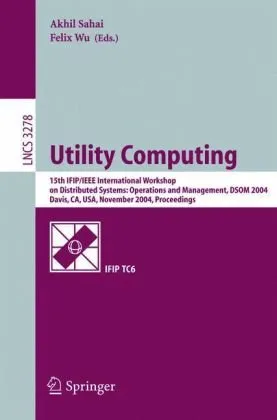
Utility Computing: 15th IFIP/IEEE International Workshop on Distributed Systems: Operations and Management, DSOM 2004, Davis, CA, USA, November 15-17, 2004. Proceedings
Markus Garschhammer,Harald Roelle (auth.),Akhil Sahai,Felix Wu (eds.)
English
Beginner
Operations Management
4.5 / 5
0 reviews
2004
Published
289
pages
304
views
This volume of the Lecture Notes in Computer Science series contains all the papersacceptedforpresentationatthe13thIFIP/IEEEInternationalWorkshop on Distributed Systems: Operations and Management (DSOM 2004), which was held at the University of California, Davis during November 1
Before you read
What will you get from this book?
This volume of the Lecture Notes in Computer Science series contains all the papersacceptedforpresentationatthe13thIFIP/IEEEInternationalWorkshop on Distributed Systems: Operations and Management (DSOM 2004), which was held at the University of California, Davis during November 15–17, 2004. DSOM2004wasthe?fteenthworkshopinaseriesofannualworkshopsandit followed in the footsteps of highly successful previous meetings, the most recent of which were held in Heidelberg, Germany (DSOM 2003), Montreal, Canada (DSOM 2002), Nancy, France (DSOM 2001), and Austin, USA (DSOM 2000). The goal of the DSOM workshops is to bring together researchers in the areas of networks, systems, and services management, from both industry and academia, to discuss recent advances and foster future growth in this ?eld. In contrast to the larger management symposia, such as IM (Integrated Management) and NOMS (Network Operations and Management Symposium), the DSOM wo- shops are organized as single-track programs in order to stimulate interaction among participants. The focus of DSOM 2004 was “Management Issues in Utility Computing. ” Increasingly there is a trend now towards managing large infrastructures and services within utility models where resources can be obtained on demand. Such a trend is being driven by the desire to consolidate infrastructures within - terprises and across enterprises using third-party infrastructure providers and networked infrastructures like Grid and PlanetLab. The intent in these init- tives is to create systems that provide automated provisioning, con?guration, and lifecycle management of a wide variety of infrastructure resources and s- vices, on demand.
Ask this book
Your question is answered in the context of this title and author. Each answer uses 2 points.
Sign in to ask the book assistant.
Reader reviews
0 reviews, 4.5 average out of 5
No reviews yet
If you have read this book, help the next reader with your experience.
Write a review
Sign in to publish a review.
Reader questions and answers
Ask a focused question and learn from the community.
Sign in to ask or answer a question.
No questions yet
Be the first to ask a clear, useful question.
What to read next
Related references that continue this learning path.
Get it Done On Time!: A Critical Chain Project Management/Theory of Constraints Novel
Eric Bergland (auth.)
2016
View book
Total Productive Maintenance: Strategies and Implementation Guide (Systems Innovation Book Series)
Tina Agustiady,Elizabeth A. Cudney
2023
View book