

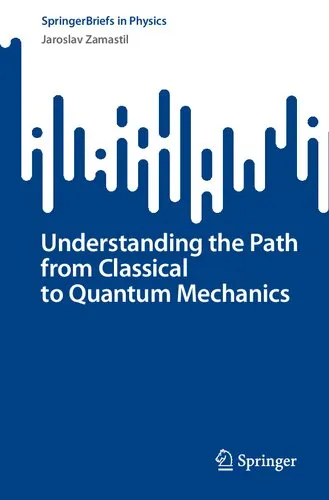
Book guide and evaluation
Understanding the Path from Classical to Quantum Mechanics
Jaroslav Zamastil
English
Beginner
Physics
4.6 / 5
0 reviews
-
Published
68
pages
284
views
Introduction Welcome to Understanding the Path from Classical to Quantum Mechanics, a book that serves as a guiding companion through one of the most significant paradigm shifts in the history of physics. In this text, we trace the intellectual journey that bridges the d
Before you read
What will you get from this book?
Introduction
Welcome to Understanding the Path from Classical to Quantum Mechanics, a book that serves as a guiding companion through one of the most significant paradigm shifts in the history of physics. In this text, we trace the intellectual journey that bridges the deterministic comfort of classical mechanics with the probabilistic elegance of quantum mechanics. Whether you are a student, a professional physicist, or a curious mind, this book will provide the clarity and depth you need to understand the fundamental principles that underpin modern physics.
Throughout the history of science, transitions from one prevailing theory to another have often sparked revolutions in how we perceive the universe. The leap from classical to quantum mechanics is perhaps the most remarkable of these revolutions. This book demystifies both domains, illustrating their key principles, contrasting their core philosophies, and explaining how quantum mechanics emerged as a necessary framework to describe the microscopic world.
Summary of the Book
The book is structured to carefully guide readers through foundational concepts of classical mechanics before diving into the emergence, formulation, and applications of quantum mechanics. The journey begins with an in-depth look at Newtonian mechanics, Lagrangian and Hamiltonian formalisms, and their elegant determinism. From there, it transitions to the mounting evidence that challenged classical assumptions, such as black-body radiation, the photoelectric effect, and atomic spectra.
As the narrative progresses, the book introduces the pioneers of quantum theory—Planck, Einstein, Bohr, Heisenberg, and Schrödinger—and explains their groundbreaking contributions. Quantum principles such as wave-particle duality, the uncertainty principle, and the superposition of states are addressed with clarity and rigor. Through straightforward language and numerous examples, the book not only explains quantum mechanics' abstract mathematics but also aligns its philosophical implications with its physical predictions.
Additionally, the book explores how these two seemingly distinct domains coexist. Advanced topics such as semiclassical mechanics and the correspondence principle are discussed to illustrate the continuity between classical and quantum worlds.
Key Takeaways
- 1. Fundamental Principles: Gain a clear understanding of Newtonian mechanics' key principles and smoothly transition into the abstract yet fascinating world of quantum mechanics.
- 2. Historical Origins: Explore the pivotal experiments and crises that questioned the completeness of classical physics and necessitated quantum theory.
- 3. Core Concepts of Quantum Mechanics: Learn about concepts like wavefunctions, probability amplitudes, and operators in a reader-friendly manner.
- 4. Philosophical Insights: Reflect on how quantum mechanics challenges our intuitions about reality, determinism, and causality.
- 5. Bridging the Worlds: Understand how classical mechanics and quantum mechanics coexist and where their theories apply.
Famous Quotes from the Book
"To fully comprehend quantum mechanics, one must first understand the inevitability of its emergence from the cracks in classical determinism."
"Physics is not just a collection of equations; it is a dialogue with nature, bridging the gap between observation and imagination."
"In quantum mechanics, certainty is replaced by probability, but beauty persists in the realm of possibilities."
Why This Book Matters
Physics students, enthusiasts, and practitioners often find themselves grappling with the abstract formulations of quantum mechanics. This book serves as a bridge, not only between two historical paradigms but also between abstract theory and tangible understanding.
By combining historical narratives with modern interpretations, Understanding the Path from Classical to Quantum Mechanics encourages readers to see physics as an evolving discipline shaped by human curiosity and ingenuity. It reminds us that every unanswered question today is a seed for a scientific revolution tomorrow.
Moreover, this book goes beyond mere equations to emphasize the philosophical and practical implications of the quantum revolution, making it a unique and indispensable resource for anyone interested in the nature of reality itself.
Ask this book
Your question is answered in the context of this title and author. Each answer uses 2 points.
Sign in to ask the book assistant.
Reader reviews
0 reviews, 4.6 average out of 5
No reviews yet
If you have read this book, help the next reader with your experience.
Write a review
Sign in to publish a review.
Reader questions and answers
Ask a focused question and learn from the community.
Sign in to ask or answer a question.
No questions yet
Be the first to ask a clear, useful question.
What to read next
Related references that continue this learning path.


Modern Computer Vision with PyTorch: A Practical Roadmap From Deep Learning Fundamentals to Advanced Applications and Generative AI, 2nd Edition
V Kishore Ayyadevara,Yeshwanth Reddy
2023
View book