Loading
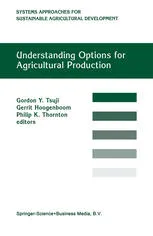
Cover of Understanding Options for Agricultural Production
English Intermediate novel

Understanding Options for Agricultural Production

G. Uehara,G. Y. Tsuji (auth.),Gordon Y. Tsuji,Gerrit Hoogenboom,Philip K. Thornton (eds.)

Philip K. Thornton (eds.)

4.3 / 5

0 reviews

1998

Published

404

pages

591

views

The first premise of this book is that farmers need access to options for improving their situation. In agricultural terms, these options might be manage­ ment alternatives or different crops to grow, that can stabilize or increase household income, that reduce soil degradation a

About this book

The first premise of this book is that farmers need access to options for improving their situation. In agricultural terms, these options might be manage­ ment alternatives or different crops to grow, that can stabilize or increase household income, that reduce soil degradation and dependence on off-farm inputs, or that exploit local market opportunities. Farmers need a facilitating environment, in which affordable credit is available if needed, in which policies are conducive to judicious management of natural resources, and in which costs and prices of production are stable. Another key ingredient of this facilitating environment is information: an understanding of which options are viable, how these operate at the farm level, and what their impact may be on the things that farmers perceive as being important. The second premise is that systems analysis and simulation have an impor­ tant role to play in fostering this understanding of options, traditional field experimentation being time-consuming and costly. This book summarizes the activities of the International Benchmark Sites Network for Agrotechnology Transfer (IBSNAT) project, an international initiative funded by the United States Agency for International Development (USAID). IBSNAT was an attempt to demonstrate the effectiveness of understanding options through systems analysis and simulation for the ultimate benefit of farm households in the tropics and subtropics. The idea for the book was first suggested at one of the last IBSNAT group meetings held at the University of Hawaii in 1993.

Ask this book

Your question is answered in the context of this title and author. Each answer uses 2 points.

Sign in to ask the book assistant.

Reader reviews

0 reviews · 4.3 average out of 5

No reviews yet

If you have read this book, help the next reader with your experience.

Write a review

Sign in to publish a review.

Reader questions and answers

Ask a focused question and learn from the community.

Sign in to ask or answer a question.

No questions yet

Be the first to ask a clear, useful question.

Related references that continue this learning path.